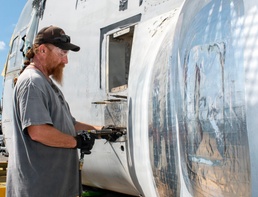
MARINE CORPS AIR STATION CHERRY POINT, N.C. – Imagine a military aircraft sustaining heavy structural damage in a remote, forward-deployed combat location. If the repairs are outside the scope of standard squadron-level maintenance and shipping the aircraft to a depot is not an option, how does the fleet rapidly repair and return that critical asset to the fight?
This high-stakes question drove Fleet Readiness Center East (FRCE) to host the command’s second annual forward-deployed combat repair training exercise May 18-22. The exercise was designed to sharpen skills and increase readiness of the Naval Air Systems Command (NAVAIR) Forward Deployed Combat Repair (FDCR) Team, an elite group of Navy Reservists and skilled depot-level artisans, engineers and planners and estimators who deploy worldwide – afloat and ashore – to rapidly repair and return battle-damaged aircraft to the fleet.
This five-day training evolution embedded the participants into a scenario designed to mirror conditions the team is likely to encounter if deployed in support of the warfighter. With a goal of increasing operational readiness, the event allowed FRCE artisans, Navy Reservists and Marines to build working relationships, gain experience with real-world deployment challenges, and enhance aircraft maintenance and repair capabilities.
FRCE Commanding Officer Capt. Randy Berti said training exercises like this are essential to maintaining fleet readiness and maximizing lethality.
“Providing artisans and service members with this invaluable training opportunity is exactly how we sustain the world’s most lethal fighting force,” said Berti. “No mission goes exactly according to script, and every minute an aircraft spends on the ground during a mission carries a massive cost. That is why this immersive experience is so important. It forces the team to troubleshoot complex repairs while under pressure now – laying that foundation – so they aren’t facing high-stakes challenges for the first time in the field when it matters most.”
FRCE supported the training event with aircraft and a cross-disciplinary team of engineers, planners and estimators and artisans who are assigned to the FDCR mission to work alongside the service members and execute repairs.
While repairs may be performed by squadron personnel, aircraft battle damage repairs often require specialized repair and damage analysis, skills and tools from depot-level maintainers. The exercise was a great opportunity for the depot-level artisans and engineers and service members to learn from each other, said Navy Capt. Jim Mcdonnell, a Reservist on the NAVAIR FDCR Team.
“FRC East’s artisans are the experts; they’ve been doing this for years,” said Mcdonnell. “The intermediate- and organizational-levels don’t necessarily have all the capabilities that FRC East can bring. The Marines had some of this type of training in A School, but they don’t get to practice it. The level of repair that they did here allowed them to sharpen their skills. They really enjoyed being able to learn battle damage repair from a skilled artisan, which is especially helpful because tricks of the trade aren’t easily taught in school. It was a great opportunity for us to develop our skill sets for when we are deployed.”
During the exercise, the 52 participants were split into three teams. Each team navigated a distinct hypothetical deployment scenario and was responsible for repairing an aircraft – either an MV-22B Osprey or CH-53E Super Stallion – with simulated battle damage.
Just like a deployment, the team’s resources were extremely limited during the exercise. Artisans and engineers only had the minimal tooling they were able to bring, if any, and the equipment that would normally be present in a deployed environment to complete the repairs. This can be especially challenging as they don’t always know what needs repairing until they arrive, according to Field Team Shop Supervisor Clifton Force, who oversees the depot’s FDCR Team.
“Oftentimes, these guys don’t know what they are going to be dealing with until they get there,” said Force. “They have to be adaptable and extremely resourceful because their FDCR kit may be the only source of tooling they have to fix complex damages. They have to look at what they have, look at what’s broken and figure out a way to make it work to get the aircraft back in the air.”
Building onto the foundation of last year’s iteration, this year’s team was larger, allowing them to tackle more repairs and test new, advanced repair technologies, said Mcdonnell.
“Not only are we getting more people trained, but we are doing more repairs on more aircraft,” Mcdonnell said. “Marine Aviation Logistics Squadron 14 and 26 sent out aircraft maintainers from their intermediate-level maintenance facilities to support the exercise. We also incorporated fiber optic repairs to evaluate possible tooling and prototypes the team can use to repair fiber optic cables in the field. All three of these built onto our overall capability, allowing us to be more prepared for when we need it.”
By putting their skills to the test in a high-pressure, simulated combat environment, the participants walked away with far more than just practice – they left with a proven capability to sustain the fleet anywhere in the world, Force said.
“At the end of the day, our goal here was to increase readiness and we did exactly that,” Force said. “Not only are the artisans, engineers and planners from FRC East more prepared to support the warfighter, but so are the Reservists and Marines.”
FRCE is North Carolina's largest maintenance, repair, overhaul and technical services provider, with more than3,600civilian, military and contract workers. Its annual revenue exceeds $865 million. The depot provides service to the fleet while functioning as an integral part of the greater U.S. Navy; Naval Air Systems Command; and Commander, Fleet Readiness Centers.