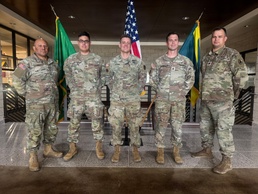
Soldiers with the 156th Information Operations Battalion, 56th Theater Information Operations Group, based at Joint Base Lewis-McChord, Washington, were gassed, shot down simulated drones, ruck marched through the June heat, rescued downed helicopter pilots, crafted military deception plans and conducted countless briefings as they honed their information operations skills and competed to earn the title of best field support team.
Four teams from Alpha and Bravo companies, 156th Information Operations Battalion, are competing in exercise Operation Athens, an information operations challenge designed to test their Soldier skills, leadership and information operations expertise in preparation for upcoming missions, according to 156th IO Battalion Commander Lt. Col. Joseph L. Trudeau.
Information operations have been around since the beginning of warfare, documented in works such as Sun Tzu’s “The Art of War,” which detail the art of information influence and deception to impact the outcome of military operations, said Trudeau. Information operations help commanders shape what adversaries, allies, and the public know and believe while protecting our own information and decision-making.
For this competition, each team will develop an IO plan to support the commander's overall goals from an informational influence perspective, as opposed to an infantry battalion, which is likely to rely on kinetic tactics to impact the battlespace.
IO is varied, and each of the four teams could develop four different primary ideas for their overall plan, ranging from staging a concert to positively influence the population, conducting a year-long communications strategy, or launching an electronic deception plan.
Unlike infantry units that employ their own weapons and equipment, information operations field support teams rely on information-related capabilities provided by other organizations. Their success depends on coordinating assets such as public affairs, psychological operations, civil affairs, cyberspace operations and combat camera to achieve the commander's objectives.
“Working groups and briefs are our bread and butter,” said Maj. Jesse Morgan, Alpha Company S3 for the 156th IO BN, 56th TIOG, who participated in exercise Operation Athens as a competitor in years past. “Being able to run a working group well is critical to success because we, as IO professionals, don’t ‘own’ any of the (assets)” used to shape the battle space, said Morgan.
“Without a professional briefer, nobody’s going to take you seriously, and you’re never going to get anything done,” said Morgan.
While some of the teams, which vary in size from four to eight Soldiers, have been working together for a while, others are composed of new Soldiers, which creates an interesting dynamic.
“All six of us have never worked together before,” said Capt. James Holland, Alpha Co., team 1 team leader, 156th IO BN, 56th TIOG. “This very much represents the actual reality of the way that the National Guard works,” he said. Sometimes, information operations field support teams are comprised of those who are available, due to civilian work schedules or other events, he said.
“Your team comes together a little while before mobilization, you train together and then you head out the door,” said Holland, who has a combat arms background and recently moved into the IO unit.
“So far, we have been together for 72 hours. At the end of it, I want us to become a cohesive unit. I want us to be able to go from six men who have never met each other to a team that can handle complex problems,” said Holland.
On the opposite end of the spectrum is Maj. Byron G. Adams, field support team leader, Bravo Company, 156 IO BN, 56 TIOG, who has more than 10 years of experience in information operations and has been to every military school offered on the topic. His team comprises many Soldiers who have deployed in support of IO.
“My main role at this point in time is to really train up the next group,” said Adams. “I’m here to make sure my senior NCOs, my junior NCOs, and my junior officers all know what right looks like and how to effectively run an information warfare group,” said Adams, who runs a briefing room like a seasoned professional, quickly running through talking points, outlining tasks, gathering new information, and tasking his team efficiently.
IO teams must be professional and competent in the briefing space to be effective. “Often, when we’re deploying, we’re working with general officers,” said Trudeau. “At some point, you will be in front of that high-ranking commander briefing your plan, seeking approval.”
While each team has a variety of experience levels, backgrounds, and different styles of managing IO, they all agree that taking the time to conduct soldier skills training is beneficial and they appreciate the opportunity to get those repetitions in when possible.
“While a majority of our job is on the computer, with data analysis and working with human beings, during this exercise we’ve had a tactical infiltration that involved different decision-making criteria,” said Holland. “Rather than just focusing on a computer, we got to go outside, put on our kit and exercise some more of the field-related tests than simply Microsoft Teams.”
“At the end of the day, everyone is a rifleman,” said Adams. “I think it’s a fantastic opportunity,” he said about the ruck march, land navigation, and CS chamber elements of the exercise. “We need to be able to earn the respect of those around us,” said Adams. “If we can’t do the simple things we are asking the infantry platoons to do, we’re not going to get the same receptive response that we're looking for.”
The exercise challenged participants to demonstrate both technical expertise and Soldier fundamentals, while the competition itself encouraged teamwork, continuous improvement and professional excellence.
"Competitions inherently inspire people to be better," said Lt. Col. Joseph L. Trudeau. "They inspire people to try new things, take a little more risk, and they're fun."
Holland agreed, saying the competition element would pull his team closer together. Since the tactical shooting and IO briefs are factored into the final score, the playing field balances out. While some teams are experienced IO practitioners, others may have more Soldier skill savvy.
When the scores were tallied, Maj. Byron G. Adams' Bravo Company field support team earned top honors, taking home the title of best field support team after demonstrating excellence across both tactical Soldier tasks and information operations planning and briefing events.
For Adams, the victory reflects more than a single team's performance. It reinforces the value of developing the next generation of IO professionals and ensuring every Soldier is prepared to support commanders in increasingly complex operational environments.