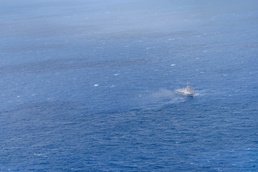
As multinational forces participating in Exercise Rim of the Pacific (RIMPAC) 2026 prepare to conduct a sinking exercise (SINKEX) in the waters surrounding Hawaii, Naval Supply Systems Command (NAVSUP) Fleet Logistics Center (FLC) Pearl Harbor is providing the logistics support necessary to help make one of the exercise's most complex training events possible.
SINKEX, a live-fire exercise involving a decommissioned vessel, provides participating nations an opportunity to integrate surface, subsurface and aviation assets in a realistic maritime environment. While the event highlights the capabilities of ships, aircraft and weapons systems from allied and partner nations, its success depends on extensive coordination and sustainment efforts occurring behind the scenes.
As the primary logistics integrator for RIMPAC 2026, NAVSUP FLC Pearl Harbor coordinates transportation, contracting, material management and fleet support services that enable participating units to remain mission ready throughout the exercise.
“Exercises like RIMPAC demonstrate that logistics is a warfighting capability,” said Cmdr. David Francia, NAVSUP FLC Pearl Harbor director of operations. “Every movement, every requirement and every support action contributes to operational readiness. Our mission is to ensure participating forces have the resources they need to execute training safely and effectively.”
For LS3 Hector Napoles, NAVSUP FLC Pearl Harbor's 2025 Junior Joint Warfighter of the Year and a first-time RIMPAC participant, the exercise has reinforced how individual logistics actions directly contribute to fleet readiness. Serving as a logistics support representative for guided-missile cruisers and destroyers participating in the exercise, Napoles sees firsthand how sustainment enables combat readiness.
“Something I do every day, such as delivering CASREPs and scheduling stores deliveries, directly impacts the larger mission when done correctly,” said Napoles. “By supporting these ships and helping them fulfill their requirements, I am helping them support the carrier and the carrier strike group mission.”
His experience has also highlighted the teamwork required to sustain a multinational force operating at a high tempo.
“The most rewarding part of being in this team is being able to find solutions to complex issues,” Napoles said. “This experience has shown me that sailors care beyond their unit's mission. They also care about taking care of each other and helping solve problems wherever they can.”
RIMPAC, the world's largest international maritime exercise, brings together forces from around the globe to strengthen partnerships, enhance interoperability and promote a free and open Pacific. The biennial exercise provides participating nations an opportunity to train alongside one another in complex and realistic scenarios designed to improve collective readiness.
Supporting an exercise of this magnitude requires months of planning and coordination. Through its Logistics Support Center and integrated logistics teams, NAVSUP FLC Pearl Harbor works closely with fleet commanders, installation partners, service providers and participating nations to synchronize support requirements across Hawaii. The command's efforts include coordinating transportation services, contracting actions, supply support and other critical logistics functions that allow participating units to focus on mission execution.
While sailors participating in SINKEX will execute the live-fire event, Napoles takes pride in supporting the effort from behind the scenes.
“I am happy that I am part of the process that makes SINKEX successful,” he said.
While ships, aircraft and personnel participating in SINKEX may occupy center stage, logisticians across NAVSUP FLC Pearl Harbor are helping ensure participating forces have the support required to execute the mission.
“When people watch SINKEX, they'll see ships, aircraft and weapons systems working together,” Francia said. “What they may not see are the logisticians working behind the scenes to ensure those units have the fuel, supplies and support they need to be there. Knowing that our efforts help make that possible is something I'm proud of.”
The SINKEX event provides participating nations an opportunity to validate tactics, techniques and procedures while exercising command-and-control capabilities in a multinational environment. It also demonstrates the interoperability and collective strength that underpin regional security and maritime stability throughout the Pacific.
For NAVSUP FLC Pearl Harbor, the event represents more than a logistics challenge. It highlights the critical role sustainment plays in enabling operational success and delivering combat-credible forces.
As RIMPAC 2026 continues, the command remains focused on providing responsive and integrated logistics support to participating forces, ensuring they remain ready to execute missions ranging from humanitarian assistance and disaster response to high-end maritime operations. While ships, aircraft and personnel participating in SINKEX may occupy center stage, the exercise underscores a fundamental truth shared across the fleet: combat power begins with logistics.
Naval Supply Systems Command provides supply, acquisition and logistics support to the Navy and joint force worldwide. As one of its 11 subordinate commands, NAVSUP Fleet Logistics Center Pearl Harbor enables forward operations and sustains fleet readiness throughout the Pacific. Headquartered in Mechanicsburg, Pennsylvania, NAVSUP employs more than 22,500 military and civilian personnel. In coordination with the Navy Supply Corps, NAVSUP delivers the logistics capabilities required to sustain naval forces and support operational readiness.
Thirty nations, over 30 surface ships, five submarines, 15 national land forces, more than 206 aircraft and 30,000 personnel are participating in RIMPAC in and around the Hawaiian Islands, June 24 to July 31. The world's largest international maritime exercise, RIMPAC provides a unique training opportunity while fostering and sustaining cooperative relationships among participants critical to ensuring the safety of sea lanes and security on the world's oceans. RIMPAC 2026 is the 30th exercise in the series that began in 1971.