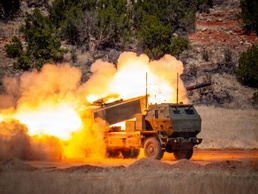
The Colorado Army National Guard’s 3rd Battalion, 157th Field Artillery Regiment integrated High Mobility Artillery Rocket System launchers directly into the U.S. Army’s 4th Infantry Division’s new digital network during the Ivy Mass 2026 exercise, May 4-20, 2026, at Fort Carson, Colorado Springs, Colorado.
The successful test is the first of its kind in the U.S. military and resulted in a fast, automated digital rocket fire mission, proving that COARNG units can integrate directly into active-duty targeting systems.
The trial streamlined the regiment’s role in processing fire missions by using a revolutionary AI-powered targeting system. Previously, fire missions required human operators to manually route, check and approve targeting information, creating significant bottlenecks.
Under the new system, targets were matched significantly faster than human operators can. 3-157 Soldiers maintained a supervisory role, keeping the final authority to approve or cancel a mission.
“This initiative will streamline and expedite the full kill chain from target detection to development to execution,” said U.S. Army Lt. Col. David Graves, commander, 3-157 FA. “Taking part in this exercise allows the regiment to be a ‘fast-follower’ as new technology comes online.”
To make the system work, 3-157 had to overcome several equipment limitations. Because older military computers lack the graphics power to run the new mapping software, commercial tablets were used instead. To connect with existing military hardware, 3-157 integrated a smart tactical radio directly into the HIMARS cab to act as a mobile field router. This setup allowed the launcher to serve as a high-speed data hub on the local network.
The regiment successfully qualified two HIMARS crews, demonstrating the unit’s ability to execute high-tech operations under realistic field conditions.
The exercise also integrated the tactical Link 16 network used by the Colorado Air National Guard. While aircraft routinely use this high-speed network to share data during large-scale operations, air and ground units rarely get to train on the network together.
“Ivy Mass gave both air and ground components of the CONG an opportunity to work through the logistics required to ensure the datalinks will be operational when it matters most during combat operations,” said U.S. Air Force Col. Christopher Melka, Operations Group commander,140th Wing, COANG.
Link 16 allows fighter jets and ground launchers the ability to deconflict fires and pass secure messaging between ground and air assets.
“The integration into the airspace is invaluable,” said The Adjutant General of Colorado U.S. Army Maj. Gen. Robert Davis. “The value of this work cannot be overstated.”