Insect-borne illnesses have been a significant threat to U.S. forces overseas since the earliest deployments in the history of the nation’s military, and remain a constant danger to operations in the present day.
These illnesses, how they are transmitted, and the areas that they affect are in constant flux due to numerous factors requiring vigilant research and surveillance efforts.
Naval Medical Research Unit (NAMRU) SOUTH oversees this mission for the SOUTHCOM area of responsibility (AOR), working alongside multiple international, academic and industry partners to stay abreast of illnesses that could impact warfighter readiness.
Part of that oversight requires constant surveillance of vectors: means by which disease is transmitted to humans. Specifically, researchers must stay abreast of the habits, reproduction and geographical spread of certain disease-bearing insects.
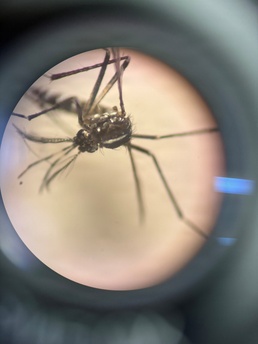
In April, researchers with NAMRU SOUTH confirmed the identification of Ae. albopictus (also known as the tiger mosquito), an insect from southeast Asia only recently reported in the northern Peruvian Amazon.
“Researchers were able to recover larvae from the mosquitos collected in a rural area of Iquitos city, Loreto,” said Gissella Vasquez, deputy head of the command’s Entomology department, “and confirm the species when they matured into adults.”
“This finding provides insight into the speed with which an introduced vector species can disperse along with human movement through riverine habitats,” added Lt. Cmdr. Ryan Moore, with NAMRU SOUTH. “Its early detection will allow for the modification of current vector-borne disease (VBD) outbreak mitigation strategies.”
Previously in Peru, the spread of certain insect-borne diseases such as dengue, yellow fever, chikungunya and Zika were dictated largely by another mosquito species, Aedes aegypti (also known as the Egyptian mosquito – itself a species once native to North Africa that can now be found across the globe). With the introduction of another potential vector, researchers must account for how the unique behaviors of this species, such as preference for indoor or outdoor feeding, host seeking and preferred breeding habitat, might affect the spread of disease in the country.
“Infectious diseases transmitted by biting arthropods, like dengue and malaria, have historically caused more military casualties and operational disruptions in overseas deployments than direct combat,” explained Henju Marjuki, chief science officer for NAMRU SOUTH. “Therefore, implementing robust vector-borne disease surveillance is critical for U.S. warfighters, ensuring force health and preserving operational readiness.”
NAMRU SOUTH maintains a strong working relationship with Peruvian governmental health organizations to provide VBD outbreak response. The command collaborated closely with Peru’s National Center for Epidemiology Disease Prevention and Control as well as Loreto Regional Health Directorate to identify this potential new disease vector.