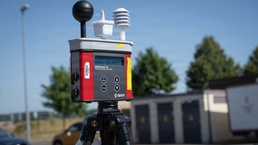
SPANGDAHLEM AIR BASE, Germany — As temperatures climbed across Europe during a late-June heatwave, the 52nd Operational Medical Readiness Squadron’s bioenvironmental engineering flight increased its monitoring efforts to protect Airmen working outdoors.
U.S. Air Force Senior Airmen John Cates and Kellie Memoli, both 52nd OMRS bioenvironmental engineering technicians, spent June 25 recording wet bulb globe temperature readings across the installation.
Unlike a standard thermometer, a WBGT monitor measures air temperature, humidity, radiant heat, and wind conditions to provide a comprehensive assessment of environmental heat stress.
“You never know when you’ll be hit with your next heatwave,” Memoli said. “So, we make sure all of our equipment, like the WBGT, is good to go and operational. Without it, it’d be difficult for us to relay important updates, like heat advisories, to the command post.”
Throughout the day, personnel collected readings and distributed updated heat condition information.
This real-time data enables commanders and supervisors to adjust work-rest cycles, hydration requirements, and recovery periods for units conducting outdoor training, maintenance, and flight line operations.
By identifying and evaluating occupational hazards, bioenvironmental engineers play a critical role in ensuring personnel can safely accomplish the mission, even during extreme weather conditions.