NASA Astronaut and Artemis II Pilot Victor Glover Returns to NPS to Share Experiences, Engage Students
By Dan Linehan
On June 16, just over two months after buzzing 4,067 miles above the Moon’s far side and breaking Apollo 13’s distance-from-Earth record, U.S. Navy captain and Artemis II pilot Victor Glover returned to the Naval Postgraduate School (NPS).
He presented for NPS’ Secretary of the Navy Guest Lecture Series and met with a dozen mid-career officer students from the Department of System Engineering and Space Systems Academic Group (SSAG) to review their mission-driven research and tour their laboratories.
Glover graduated from NPS in 2009 with a Master of Science in Systems Engineering and a space systems fundamentals certificate. His research focused on flight testing new technology for underwing systems carried by F/A-18E/F Super Hornets and other aircraft.
“This place is very special,” Glover said enthusiastically during his presentation, titled “From Monterey to the Moon (and Back).” Glover joked that the words “and Back” were the most important part — something his fellow Artemis II crewmates commander Reid Wiseman (also an NPS alum), mission specialist Christina Koch (a NASA researcher), and mission specialist Jeremy Hansen (from the Canadian Space Agency) would most certainly agree.
Artemis II launched the four astronauts around the Moon in April. Prior to this cosmic achievement, our closest neighbor in the Solar System hadn’t received Earthling visitors in more than 50 years. That visit was made in 1972 by Apollo 17 under the command of retired U.S. Navy Capt. Gene Cernan (another NPS graduate). Cernan remains the last human to walk on the Moon, but upcoming Artemis missions promise not only more treks across the lunar surface but also astronauts living on the Moon for extended durations.
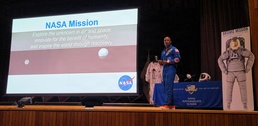
In Glover’s presentation, he talked about his Moon mission and the trajectory his life took to become a naval aviator, test pilot, and then astronaut. His awe-inspiring stories thrilled a full house of around 1,300 students, faculty, staff, kids and family, and community members. The public also viewed the livestream broadcast.
After flying combat in F/A-18 Hornets for the Navy, Glover attended test pilot school at Edwards Air Force Base, which is the legendary home of the X-planes. He then deployed to Naval Air Weapons Station China Lake as a test pilot and was also ready to elevate his education.
Glover reflected on the challenges of being test pilot, growing his family, and wanting to pursue an advanced degree. When the time came to choose a graduate school, Glover said NPS became his top choice by far when he factored in quality of education, relevance of his continuing studies to Navy priorities, and the flexibility to work on a demanding degree while facing the daunting challenges of being a test pilot.
“While I was at China Lake, I actually was an NPS hybrid student. I did the systems engineering distance learning program — product development for the 21st century,” said Glover, as he traversed the auditorium stage flanked by a collection of NASA artifacts on loan to NPS, including space helmets and a spacesuit belonging to Cernan.
“And I will tell you; it was such an amazing part of my life ... I'm doing grad school homework, and I’d just come from the flightline, flying the Super Hornet as a test guy,” he said.
Both NPS and China Lake encouraged Glover to bring his schoolwork into flight testing, and flight testing into his schoolwork. As he noted, each significantly enhanced the other.
“My boss at China Lake and my thesis advisor Mark Rhoades were both giving me inputs on how to make my project useful academically and useful to real-world applications,” Glover added. “To me, that is one of the biggest values of NPS. It even allows students to do classified research. There aren’t many universities where you can do that, and so that’s a great benefit.”
On the second day of Glover’s visit, he engaged with NPS graduate students from his parent departments, systems engineering and space systems, to learn more about current thesis research. Three of the students Glover spoke with were ensigns in a fast-track master’s program on their way to flight school and were inspired by his example. At NPS, they studied and conducted research with cutting-edge technology that will help jump-start their aviation careers.
“Our officers come to NPS and learn how to better apply their crafts in data-driven ways. And they become better thinkers. When they go back to the fleet, they make better decisions and lead based on data,” said Glover.
U.S. Marine Corps Lt. Col. Brian Neri, a former AV-8B Harrier pilot and department head, was one of the students in the space systems operations and engineering curricula who briefed Glover.
Neri is a member of the student-faculty research team that designed and built a space-based, terahertz imaging camera that is set to be deployed to the International Space Station (ISS) in 2027. The camera monitors oxygen emissions in the upper atmosphere and can be used to detect objects leaving or entering space. Glover was keen to learn more as the system is finalized and prepared for launch early next year.
NPS has decades of experience building and launching satellites and instruments used for space. Glover also visited the mission control room where NPS tracks CubeSats in orbit and runs the Mobile CubeSat Command and Control (MC3) ground network that encircles the planet.
Inspired by meeting Glover and his words, Neri said, “Captain Glover really focused on unity and teamwork, and that really resonated with me. I was one of many members that worked on this camera, and it would not have happened without all the students, faculty, and staff developing it over the years.”
Neri, who graduated with master’s degrees in both space systems operations and applied physics this month, also believes Glover’s message of the importance of being a lifelong learner for all people. And says he vows to continue adhering to this practice.
After a long career as an aviator, Neri will now apply his NPS education to the more rarified atmosphere of Marine space operations.
Before attending NPS as a system engineering student, U.S. Navy Lt. Jaia Friesen served in the fleet as a surface warfare officer. She brought this experience into her research on space weather’s effects on radar components in relation to missile engagement by AEGIS combat systems aboard vessels operating in the Arctic.
Space weather — such as geomagnetic storms, radio blackouts, and solar radiation — produces more extreme impacts at the high latitudes. So, as conditions in the Arctic undergo rapid change, there’s an urgent need for better understanding of the operational environment.
Glover related to Freisen’s interest in the Arctic and the importance of her research, and he was curious about the ships she served aboard, her experiences working with the AEGIS combat system, and her time at sea.
Friesen also briefed Glover and listened to his presentation. She was impressed by his entire outlook and how relatable he was. “Captain Glover is just so inspirational and has an incredible drive to always better himself,” she said. “And by bettering himself, he’s really getting the best out of those around him.”
After graduating with a Master of Science in Systems Engineering with the 2026 Spring Quarter cohort this month, Friesen now heads off to engineering duty officer school to finish her training and will then become an engineer at Naval Surface Warfare Center Dahlgren Division.
“NPS is extremely special to me because it’s one of the few universities where a significant amount of the faculty has military experience,” said Friesen. “They’re very aware of your position as an officer and as a student, and they understand challenges that you’ve faced to get here and will face after graduation.”
Neri and Friesen both graduated on June 18, along with more than 400 other NPS students in the Spring Quarter class, representing just a sample of all the mission-driven research that continues to thrive across all disciplines throughout NPS.
Four-time space shuttle astronaut Jim Newman, former SSAG chair and NPS acting provost, introduced Glover during his presentation. “I am so glad that America is stepping up to go back to the Moon to stay, to build an Antarctic-style station, to be part of the future with our men and women representing the values, the political and spiritual freedoms that we hold dear,” said Newman.
“Great countries do great things, and our children deserve the opportunity to be an important part in the grand adventure of space exploration. Captain Victor Glover exemplifies and personifies all that NASA symbolizes for our country, particularly the value of hard work and resilience and humility.”
NPS has well over 40 astronaut alumni and former faculty, and they have flown to space on all the major space programs and spacecraft, including Mercury, Gemini, Apollo, Skylab, Space Shuttle, ISS, Soyuz, SpaceShipOne, Crew Dragon, and now Artemis.
Glover is quick to point out that he and the other Artemis II astronauts did not make it around the Moon by themselves. It took the teamwork of countless people across agencies during the mission and from the many decades even before liftoff occurred.
Newman has very high hopes for those who are still active astronauts and said, “The next Americans to land on the Moon may also be former NPS students.”
NPS, located in Monterey, California, provides warfighting-focused graduate education, including classified studies and interdisciplinary research, to advance the operational effectiveness, technological leadership and warfighting advantage of the naval service. Established in 1909, NPS offers master’s, doctoral and distance-learning certificate programs to U.S. Department of War military and civilian students, as well as to international partners, to develop warfighters and leaders who can think critically, solve complex operational problems and deliver mission-ready solutions through advanced education and research.