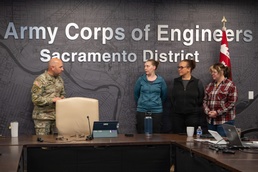
When a colleague at Sacramento District headquarters said she wasn’t feeling well,
Jerilynn Hilmar alerted those nearby, Shelley McCoy stayed close to provide comfort
and reassurance, and Elizabeth “Ellie” Hayes went downstairs to notify building security
and escort first responders back to the scene.
No cardiopulmonary resuscitation was performed and no automated external defibrillator was deployed, but their quick, coordinated response ensured she got the medical attention she needed.
For that, the three received a commander’s coin from Sacramento District Commander
Col. Robert McTighe on Dec. 8, 2025. They’re grateful for it, though they’re quick to put
it in perspective.
“What we did was important, but I don’t want it to be overinflated,” Hilmar said. “What we did could have saved someone’s life, had it been a life-threatening emergency.”
McCoy was equally measured. “None of us went into this expecting a coin or any kind of
recognition,” she said. “You recognize that there’s a coworker in distress and you take
steps to get her the help she needs. That’s it.”
For Hilmar, the value of the recognition was less about the coin and more about the
conversation it opened. At the time of the incident, AEDs were available in the building
but not on every floor, and many employees didn’t know where to find them.
According to the FDA, AEDs are portable, life-saving devices designed to treat people
experiencing sudden cardiac arrest, a condition in which the heart stops beating
suddenly and unexpectedly. The devices analyze heart rhythm and, when appropriate,
deliver an electrical shock to restore it to normal. The FDA also notes that the
combination of CPR and early defibrillation is most effective when used within the first
few minutes following a collapse.
“What I appreciated about the recognition was the opportunity to get face time with the
commander and reemphasize the need for AEDs in the building,” Hilmar said. “To me,
that acknowledgment and the immediate action that followed, that’s all I personally
needed.”
That action came quickly. Curtis Morris, Chief of Safety and Occupational Health, said
the incident prompted leadership to take immediate action, ensuring every floor the
Sacramento District occupies in the building had a device readily available. AEDs are
positioned next to restrooms on each floor and are clearly marked with signage
identifying them as an automated external defibrillator.
Morris noted that having AEDs on each floor helps resolve access issues, particularly
when an employee responding to an emergency does not have their key card, making it
difficult to move between secured floors. McCoy illustrated what that could look like in
practice. “You’re racing to go deal with this emergency and you need your key card to
get into all the doors and then all of a sudden you’re trapped in the stairwell,” she said.
“You can’t get to the AED and you can’t get back up to where it needs to be. And now
you’re useless.”
For employees who have never used an AED, Morris offered straightforward
reassurance that no prior training is required to operate one.
“You don’t actually need training to use it,” Morris said. “It talks you through everything.”
The devices provide audible, step-by-step instructions and will not activate if a heartbeat
is detected. Morris noted the devices are intended for cardiac arrest.
His first recommendation in any emergency is to call 911 before reaching for the AED.
“Make sure you call 911 first,” Morris said. “Then you can grab the AED.”
“CPR training definitely played a huge role in my involvement,” McCoy said. She had
positioned herself nearby in case chest compressions became necessary. CPR is
physically demanding, and having more than one trained person available to rotate in
can make a real difference, she added.
Hilmar also cited the importance of knowing how to call 911 effectively. In a previous
career, she called for emergency services often enough to develop a consistent script.
“When you call on a cell phone, they don’t know where you are,” she said. “You have to
get to the point. The person you’re talking to is not the one dispatching first responders.
They need to know what jurisdiction to route you to first.”
Panic has a way of making people over-explain, she said. A practiced, direct approach
can save minutes. In some emergencies, those minutes are the difference.
What Hilmar and McCoy want most is for their colleagues to know where the AEDs are,
pursue CPR and basic emergency response training, and think through the steps before
they need them.
“It’s easy to come to work, get into a routine and forget that these things happen,”
Hilmar said. “People should know what to do without thinking about it.”
Both Hilmar and McCoy encouraged colleagues to take advantage of the training,
saying the recent experience left them personally motivated to stay current. “Everybody
needs to go through it,” McCoy said, “if only to recognize an emergency and get help if
they’re not comfortable performing CPR.”
For Hayes, the incident reinforced her appreciation for the people around her. “I think we have some really spectacular people who work here,” Hayes said, singling out the
security office for its quick response. “How quickly they responded. I was very
impressed.”
For those looking to build their own readiness, the district offers a practical starting
point. “Every quarter we have a first aid, CPR, AED class. We offer it every quarter in
the building,” Morris said. The training, he confirmed, was available before the incident
and continues to be offered to all staff.
The district safety office also encourages employees to look into additional resources if
they want to get CPR, AED and Standard First Aid certified before the next scheduled
class.