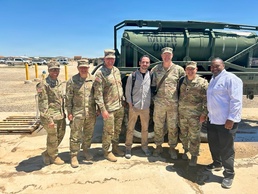
FORT BELVOIR, Va. -- Reginald Shuford, project director for Consolidated Enterprise Resource Planning (C-ERP) and Lt. Col. Stephanie Williams, system director for Global Combat Support System-Army (GCSS-A), attended Operation Jailbreak at Fort Carson, Colo., from May 12-13 to identify ways that Army business systems can fill critical gaps in a tactical environment.
The exercise, which ran from May 1-19, 2026, is an Army-wide initiative that enables vendors to validate system interoperability, and it highlighted the growing need for Army logistics, maintenance, finance and personnel data to communicate seamlessly with tactical applications.
As the first activity of the multipart Right-to-Integrate (R2I) initiative, Operation Jailbreak assembled operational units, software developers, acquisition professionals and industry partners to test non-integrated systems in a wartime scenario.
Army business systems were built to provide authoritative data that allows Soldiers to do things like order parts, pay bills, and move equipment across the entire Army. In addition, they provide leaders with the information they need to make informed decisions across the total Army enterprise.
“At Fort Carson, we saw Soldiers in the field accessing singular business processes. This is significant because we can now connect apps to specific data sets that a Soldier needs to do their job instead of accessing the entire enterprise system," said Williams.
Instead of logging into multiple complex systems from an office, Soldiers can use mobile applications on tablets or mounted devices to initiate and execute business processes directly from the field.
The goal is not to replace the Army’s major enterprise resource planning systems, such as GCSS-Army, General Fund Enterprise Business System and Logistics Modernization Program. The goal is to make system data accessible through tactical applications that function on the frontline.
“Our systems enable what the Soldier is doing in the field,” Shuford explained. “The applications being built are a way to connect Soldiers to the live transactional data inside our systems. They do not need access to the full system; they just need access to a particular data set.”
Those data sets can include anything from maintenance, warehouse shop floor or property book, which would allow a Soldier to order a new vehicle part through an app on their edge device right in the field.
“Speed is the driver,” said Shuford. “We are working quickly to be able to connect the authoritative data in our logistics systems with a variety of apps that meet a Soldier’s needs.”
For Shuford, Operation Jailbreak served as a rare opportunity to see firsthand how Soldiers use technology in operational and realistic conditions.
“Seeing Soldiers actually fight with these toolsets was eye-opening.” Shuford believes that was one of the intentions of Jailbreak: to see how Soldiers react in frustrating situations and what adjustments they make during those situations.
One of the clearest examples demonstrated during the exercise involved maintenance operations. Soldiers operating vehicles in the field could identify needed parts, check inventory and initiate requests directly from their devices, a process that enhances the user experience and relieves a Soldier’s digital burden.
Before those apps were connected, Shuford and Williams explained, the Soldier had to return to a command center, log into an enterprise system and manually navigate a complicated ordering process. The Solider would have to know the part name, the part number and their Department of Defense Activity Address Code (DoDAAC). They would then enter the information into a system, and a colleague in the command center would fulfill the order.A connected app eliminates complicated processes, builds them into the app so that the process becomes automated and requires less human interaction with the transactional core. This allows Soldiers to focus on what’s in front of them and not be burdened by administrative processes.
Shuford noted that attending the exercise gave him insight into apps being developed, and he mentioned that it gave him awareness of possible overlap among apps, apps that need added functionality or those that need to be decommissioned. The Army CIO is working on a governance process to prevent vendors from building and delivering redundant solutions.
Williams and Shuford would like to see the CPE ES2 organization involved in future Jailbreak events. “We have to get disconnected operations (DISCOPS) and some of our capabilities to be part of upcoming exercises,” Shuford said. Taking an active role in future events will allow CPE ES2 program managers to learn how capabilities are being used in the field, and it will allow industry representatives to understand what needs to be developed to further enable the Warfighter.
Williams added that her colleagues across the CPE ES2 portfolio would gain great understanding from attending future exercises. “They would be able to see Soldiers use the capabilities, interact with them and get vital feedback,” she noted. Better integration with future events provides the opportunity to identify additional capabilities, and it helps get them designed and delivered faster and interoperable with NextGenC2 and other field-ready capabilities.
Additional Jailbreak exercises are planned monthly, culminating in Project Convergence in July 2026.
The purpose for all exercises remains clear: reduce the administrative burden, speed access to critical information, establish bi-directional access to systems and allow Soldiers to focus less on paperwork and more on the mission. Shuford and Williams emphasized that connecting Soldiers with the authoritative data they need to do their jobs at any time and from any location is the next modernization focus of the Army’s business systems.