FORT EUSTIS, Va. — “As we pivot toward the crucible of large-scale combat operations (LSCO), remember this immutable truth: rapid mobility is the decisive factor in modern war,” stated Maj. Gen. Lance G. Curtis, ARTRANS commanding general. “We are the lifeblood of the Joint Force.”
For the 597th Transportation Brigade, ARTRANS, that battleground begins at the planning table.
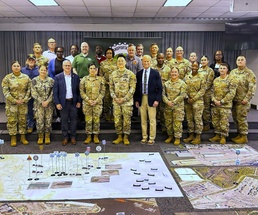
This month, the brigade’s “Rapid Support” team of Soldiers and civilian professionals executed an intensive, multi-day, End-to-End Deployment Tabletop Exercise (TTX) on June 24, 2026, in the Chapel Annex at Joint Base Langley-Eustis, Fort Eustis, Va.
The strategic training event served as a critical platform to pressure-test the systems, commercial seaport integrations, and surface distribution processes that make rapid global power projection possible.
The TTX, which was the brainchild of 597th Transportation Brigade Commander, Col. Edward K. Woo, exceeded all command expectations.
"The team hit it out of the park," said Woo. “The positive energy for [both] doctrine and what we do on a daily basis is deeply inspiring.”
“This holistic view of logistics will help us develop ironclad TTPs [tactics, techniques, and procedures] which will withstand the fury of combat,” Woo added.
Woo also cited the teamwork among organizational leaders and Department of the Army civilians, saying, “We are stronger together as an enterprise. What we did here today is the hallmark of professionalism.”
The exercise served as a vital forum to synchronize tactical capabilities with national-level strategic priorities, ensuring the brigade remains positioned to meet the demands of future conflicts.
Emphasizing the long-term, comprehensive nature of joint logistics, Maj. Gen. Curtis noted in a pre-event memo that readiness requires a complete operational perspective.
"We must view the entire defense transportation system lifecycle holistically," Curtis said, "forging ironclad tactics, techniques, and procedures that will withstand the chaos of combat."
Curtis added success in this environment relies heavily on proactive planning: "Anticipation separates the good from the great."
"This End-to-End deployment TTX is your battleground today," Curtis noted, emphasizing the exercise's value in validating the readiness of the unit's personnel and processes. "Use it to pressure-test the systems that make rapid surface power projection possible."
To bring this command intent to life, participants actively mapped out the logistical journey of military equipment from home stations, through inland transit networks, to strategic seaports, and onto ocean vessels. By physically working through these operational phases side-by-side on large-scale terrain boards and digital tracking systems, the team was able to identify and resolve potential bottleneck points in real-time.
The exercise brought together key planners and operators across the entire brigade footprint, integrating the distinct capabilities of the 841st Transportation Battalion (Charleston, S.C.) and the 842nd Transportation Battalion (Beaumont, Texas).
By analyzing real-world, high-consequence scenarios across their diverse East Coast and Gulf Coast Operational Environments (OEs), the joint team refined the speed, scalability, and precision required to project the Joint Force in future contested logistics environments.
To ensure alignment with national-level strategic priorities, the brigade hosted several senior leaders and technical experts from ARTRANS Headquarters, who participated in the exercise:
Robin Clark, Chief, International Ops West
Sean P. Manning, Chief, International Ops East
Jimmy Wiley, Chief, G3 Terminal Operations Division (G3T)
Jim Kazmierczak, Chief, Movement Operations Division
Their presence bridged the gap between tactical port operations and strategic, international movement management, providing the brigade team with invaluable insights into global supply chain resilience and maritime readiness.
While the execution of the TTX was seamless, the success of the event was the direct result of months of meticulous preparation by the G3/S3 (Operations) section.
Under the leadership of the Rapid Support S3 team, notably Capt. Whitney Hodge, who served as the primary coordinator for the event, the planning team mapped out complex logistics scenarios that challenged participants to synchronize military movements with commercial carrier capacities and port authority operations.
Through rigorous planning events like the TTX, the 597th Transportation Brigade continues to prove that it is not merely a cargo-moving organization, but a vital, strategic hub for joint military readiness.
By fostering deep partnerships with commercial ports and enhancing internal staff coordination, the brigade ensures that the nation’s strategic gateways remain secure, agile, and ready to deploy at a moment's notice.