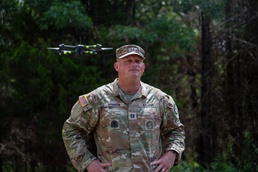
Tennessee Army National Guard Capt. Travis Robinson, commander of the Multi-Purpose Company, 3rd Battalion, 278th Cavalry Regiment, returned to military service because he missed the camaraderie, purpose and leadership opportunities he found in uniform.
A former U.S. Marine who later commissioned as an Infantry officer in the Tennessee Army National Guard, Robinson now leads one of the regiment's newest companies while helping shape the future force through one of the Army National Guard's first Small Unmanned Aircraft Systems (SUAS) Master Trainer pilot courses.
Why did you decide to join the Tennessee Army National Guard?
"After leaving the Marine Corps, I worked in law enforcement, but I realized I missed the military. I missed the camaraderie, the mentorship and having a mission bigger than myself. I also saw Tennessee Army National Guard Soldiers returning from deployments with incredible experience and professionalism. That inspired me to attend Officer Candidate School, commission as an Infantry officer and continue serving."
Why did you choose the Infantry?
"The Infantry is a brotherhood. It's demanding, but that's part of what makes it rewarding. You're surrounded by people who embrace difficult challenges and are committed to one another. There's a culture in the Infantry that pushes you to become a better leader and a better Soldier every day."
You're now commanding a newly established Multi-Purpose Company. What does that opportunity mean to you?
"It's a unique opportunity because we're building this company from the ground up. We get to establish the culture, the standards and the expectations from day one. As a commander, that's exciting because the decisions we make now will help shape the organization for years to come."
What excites you most about leading Soldiers at the company level?
"Leadership has always been the most rewarding part of military service. Watching Soldiers develop confidence, master new skills and accomplish missions together is why I serve. I have the opportunity to build teams that are prepared for future missions."
Why was it important for you to attend the Small Unmanned Aircraft Systems (SUAS) Master Trainer Course?
"As a commander, I need to understand more than just what the equipment can do. I need to understand how to build a sustainable training program so our Soldiers can confidently employ these systems. That knowledge will help us integrate unmanned aircraft systems into the company from the very beginning."
"For years, Infantry Soldiers have relied primarily on what they could observe from the ground. Small unmanned aircraft systems provide another perspective. They allow us to gain real-time information, identify terrain and potential threats before committing Soldiers forward and make better tactical decisions. It's another capability that helps us increase battlefield awareness while reducing unnecessary risk to Soldiers."
What makes this training especially exciting?
"This isn't just about learning to fly a drone. It's about understanding how to employ these systems as part of modern Infantry operations and then teaching other Soldiers to do the same. Technology continues to evolve rapidly, and we're learning from current doctrine and lessons observed in modern conflicts. Being part of one of the Army National Guard's first Master Trainer pilot courses is an incredible opportunity."
Looking back on your career, when have you thought, "This is exactly why I serve?"
"Honestly, right now. I'm standing on a military operations in urban terrain site training with unmanned aircraft systems while leading one of the Army National Guard's newest companies. I get to combine everything I enjoy about military service—leading Soldiers, serving in the Infantry and helping prepare our formation for the future. It's exactly where I want to be."
About the Small Unmanned Aircraft Systems Master Trainer Course
Among the first Small Unmanned Aircraft Systems Master Trainer pilot courses conducted in the Army National Guard, the Tennessee Army National Guard's program is evaluating a future training model designed to develop subject matter experts capable of building and sustaining unit-level unmanned aircraft systems training.
Facilitated by the Tennessee Regional Training Institute, the pilot course integrates the Army's latest doctrine, regulations and lessons observed from contemporary conflicts, preparing graduates to advise commanders on unmanned aircraft systems capabilities, risk management and employment while training future operators within their formations.
Tennessee is one of three states selected to state-fund the pilot program as the National Guard Bureau evaluates its viability for broader implementation across the force. Graduates return to their brigades and battalions as certified master trainers, extending unmanned aircraft systems expertise throughout the Tennessee Army National Guard while reducing reliance on centralized instruction.
The training directly supports the modernization of the 278th Cavalry Regiment as it transitions to a Mobile Brigade Combat Team by integrating emerging unmanned aircraft capabilities into reconnaissance, security and maneuver operations to increase battlefield awareness, enhance operational flexibility and prepare Soldiers for the evolving demands of large-scale combat operations.