JOINT BASE LANGLEY-EUSTIS, VA.–Airmen provide mission support for airfield operations daily,whether supportingfighter planes orhelicopters,but a sudden change in the atmospherecandisruptworkflowin an instant.The fluctuating nature of weather requiresAirmenadaptation: a goal Airmen must embrace to execute base asset protection, among other mission sets.
The 1stOperations Support SquadronFelker Weather FlightprovidesFortEustiswith daily forecasts; ensuringthe resiliencyand survivability of the base as apower projection platform.
Airfield Weather Operations,then-named theAir Weather Service,became part of thenewly-formedAirForcein 1947.The Air Force took onthe responsibility of providing meteorological services to the Army under the terms of the Key West Agreement, signed March1948.The 1stOSSFWFcontinues to provide mission-critical forecastsensuringthe daily operations ofaircraftandmilitary personnelsafetyatFort Eustis.
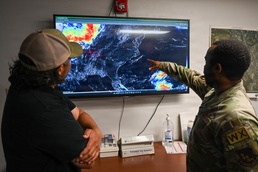
ThefourAirmenofFWF provide mission support for both the base and the airfield,theydraftforecasts 18 hours a day, which contributes to the overall protection of assets and resources from inclement weather conditions.
“Each forecaster has their own specific way of creating a forecast, but they all followthe same four specific steps,” saidTech. Sgt. Brian Sermons, 1stOperations Support Squadron noncommissioned officer in charge.“Yougatherinformation,breakdowntimeline of events, create a forecast, and then you watch it.”
TheAirmencreate their forecasts afterobservingcloud coverage, temperature, precipitation, lightning, windspeedanddirection throughout the dayusing informationfromweather sensors and processors.Theycondensethe projected weather patterns into atimelinecustomerscan understand beforepublic distribution.However,Airmenmustcontinue toobservefor changes,updatingtheir forecasts as neededto sustainbaseoperationsdue to the ever-changing nature of the weather.
“In tech school, we are given generalized knowledge of how to forecast, but when you goto the base you areforecastingfor,you start toget familiar with how localized effects, geography,topography and climatologyaffect the weather,” saidStaff Sgt.Zoe Swisher, 1stOperations Support Squadron weather craftsman.
The FWFalsoadvisesAir Traffic Controlwhentoreturn pilots from flights depending on the day’s weather projection, as well asbriefbasecommandersin preparation for upcoming stormsor exercises.FWF works with Emergency Management, base leadership, localauthoritiesand other government agencies to forecast localized changes in the weatherby the houras needed during hurricane season.
“Because we service the greater part of Virginia as a whole and as far as where our customers fly, our30-hourforecast is thestepping stonefor our mission,” said Swisher. “We have eyes in the sky that contribute to the aviation weather and mission components where we directly support our customers, and the resource protection of the base.”