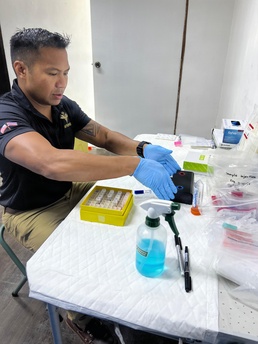
The Walter Reed Army Institute of Research – Armed Forces Research Institute of Medical Sciences conducted biosurveillance from 6 April to 16 May in support of Balikatan 2026.
Balikatan, which means “shoulder-to-shoulder” in Tagalog, is a U.S.-Philippine bilateral exercise designed to strengthen regional security and interoperability through maritime drills, coastal defense training, joint exercises, and humanitarian projects. This year, Balikatan involved more than 20 partner nations and more than 17,000 personnel.
WRAIR-AFRIMS supported the exercise by conducting pre-exercise vector surveillance and real-time infectious disease surveillance. Prior to the exercise, the biosurveillance team collected rodents, ticks, mosquitos, and other vectors and then screened them for disease threats. During the exercise, the team trained Role 1 and Role 2 providers to collect samples from U.S. personnel that the biosurveillance team could test for diarrheal and respiratory disease.
“In the Indo-Pacific, infectious disease is a major cause of disease non-battle injury,” said Maj. Sidhartha Chaudhury, Deputy Chief of Bacterial and Parasitic Diseases at WRAIR-AFRIMS. “Diarrheal disease is up there with heatstroke among the most common DNBI. By conducting outbreak detection, we provide prevention and treatment guidelines that medical units use to strategically protect force health.”
In addition to the immediate data about vector-borne and infectious disease prevalence, the biosurveillance team at WRAIR-AFRIMS provides follow-up data that allows future force health protection measures to be improved or changed.
“Long-term biosurveillance data provides deeper insights that inform treatment.” Maj. Chaudhury explained. “For example, we know that Campylobacter is a major cause of diarrheal disease. With the full-lab analyses of the samples we are given at exercises like Balikatan, we are seeing a rise in Campylobacter’s resistance to the first line antibiotics. That informs health care providers to make evidence-based decisions to better protect force health.”
WRAIR-AFRIMS continues to enhance its biosurveillance capabilities in support of other upcoming joint exercises in the Indo-Pacific, such as Talisman Sabre in Australia and Super Garuda Shield in Indonesia.
To learn more about WRAIR-AFRIMS such as our disease surveillance and other capabilities, visit the website at https://afrims.health.mil/