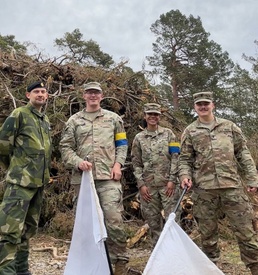
In May 2026, the Walter Reed Army Institute of Research-Europe—Middle East conducted entomology surveillance in support of Aurora 2026 in Sweden.
Aurora 2026 is Sweden’s largest annual exercise. Focused on the maritime and air domains in the Baltic Sea region, the exercise is designed to enhance readiness and interoperability among North Atlantic Treaty Organization countries. This year, the exercise included over 18,000 participants from Sweden, the U.S., and 12 other countries.
WRAIR-EME supported the exercise by conducting vector surveillance on the Swedish island of Gotland, where a significant portion of the Aurora 26 exercise occurred. Vector surveillance was conducted by trapping and analyzing ticks for diseases that pose a risk to service members participating in the exercise.
“Gotland is abundant with ticks in the springtime,” said Maj. David Denlinger, Chief Entomologist at WRAIR-EME. “In Sweden, ticks can carry Lyme disease, tick-borne encephalitis, and other disease pathogens. It’s easy to forget about them, but when you’re operating in the field during an exercise, they are a major health threat to the force.”
WRAIR-EME identified strategic locations for surveillance and collected 852 ticks from across three training areas on Gotland. WRAIR-EME collected ticks directly with leaders from Sweden’s Gotland Regiment’s Surgeon Cell and identified prime tick habitat and discussed risk in real-time while the exercise occurred.
“In Sweden, ticks are a major source of non-battle injury,” said Maj. Denlinger. “Knowledge of what species are on Gotland island during the exercise is essential to identifying what diseases pose a threat to force health. With the collaborative surveillance effort, units know what disease management strategies to use before, during, and after the exercise.”
WRAIR-EME conducts biosurveillance in support of multiple military exercises and aims to continue expanding its efforts to strengthen Force Health Protection in support of U.S. European Command and its Component Commands.
“WRAIR-EME’s biosurveillance team has collected more than 15,000 ticks this spring alone” explained Maj. Denlinger. “Vector surveillance, and biosurveillance more broadly, preserves combat power and keeps units in the fight. That’s why we do what we do.”
To learn more about WRAIR-EME, our disease surveillance, and other capabilities, visit our website at https://mrdg.health.mil/