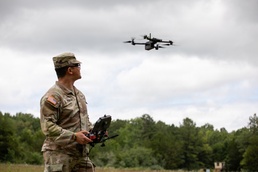
Tennessee Army National Guard Warrant Officer 1 Cedric Pierson, a 948B Electronic System Maintenance Warrant Officer assigned to the 777th Maintenance Company, 35th Division Sustainment Brigade, joined the Tennessee Army National Guard in 2015 to pursue higher education while building a long-term career.
Since enlisting, Pierson has earned an associate degree in graphic design, a bachelor's degree in music production and is currently pursuing a master's degree in cybersecurity and information assurance.
Now serving as the only warrant officer and maintenance professional attending the Small Unmanned Aircraft Systems Master Trainer Course conducted by the Tennessee Regional Training Institute, Pierson offers a unique perspective on how emerging technologies may enhance sustainment operations across the force.
Why did you join the Tennessee Army National Guard?
"I joined because I wanted an independent way to fund my education and continue building my future. The Tennessee Army National Guard gave me that opportunity. Since joining, I've been able to earn multiple degrees while continuing to serve and work full time. I'm also pursuing my master's degree."
What brought you to the Small Unmanned Aircraft Systems Master Trainer Course?
"The Tennessee Army National Guard needs master trainers for unmanned aircraft systems, and they wanted representation from different career fields. Most of the Soldiers here are infantrymen from operational units, but I'm the only warrant officer and the only maintenance professional attending the course. I'm here to understand how these systems are employed and how maintenance organizations can support those missions in the future."
What perspective does a maintenance Soldier bring to drone operations?
"The course focuses on reconnaissance and operational employment, which makes sense. From my perspective as a maintainer, I'm looking at how maintenance organizations can support those missions while also leveraging the platform. For example, there may be future opportunities to use small unmanned aircraft systems to rapidly deliver repair parts, sensors and other critical supplies to Soldiers operating in the field. It's valuable to understand how these systems are being employed across the force."
What has been the most exciting part of the course so far?
"I fly drones recreationally and hold an FAA Part 107 Remote Pilot Certificate, so getting hands-on experience with military unmanned aircraft systems has been exciting. Drones are becoming increasingly important around the world, and it's interesting to see how the Army is integrating them into operations. I've enjoyed learning alongside Soldiers from different military occupational specialties and understanding how they plan to employ these systems."
How does this training support the Army National Guard's modernization efforts?
"It's helping connect Soldiers from different backgrounds and specialties to a capability that's becoming increasingly important across the force. For me, it's about understanding how maintenance organizations can support those operations in the future and making sure we're prepared as these technologies continue to evolve."
278th Cavalry Regiment Continues Transformation to a Mobile Brigade Combat Team
As the Tennessee Army National Guard continues implementing the Army's transformation initiative, Soldiers from across the force are supporting the transition through new training and emerging technologies. One of the most significant efforts is the conversion of the 278th Cavalry Regiment to a Mobile Brigade Combat Team.
In May 2025, the Tennessee Army National Guard's 278th Cavalry Regiment was selected as one of three Army National Guard formations to transition to a Mobile Brigade Combat Team as part of the Army's transformation initiative.
The transition converts the regiment from an Armored Brigade Combat Team to a Mobile Brigade Combat Team, a formation designed to increase mobility, operational flexibility and the integration of emerging technologies across the battlefield.
A Mobile Brigade Combat Team is an enhanced Infantry Brigade Combat Team organized to conduct dispersed operations while integrating capabilities such as the Infantry Squad Vehicle, unmanned aircraft systems, extended-range precision fires and electronic warfare systems.
As the transition progresses, the regiment is fielding new equipment, training Soldiers on emerging systems and reorganizing to align with the new force structure.
Prior to the transition, the 278th consisted primarily of M1 Abrams tanks and Bradley Fighting Vehicles organized across six squadrons: three armored squadrons, one support squadron, one field artillery squadron and one engineer squadron. The regiment included more than 3,500 Soldiers.
Under the new force structure, the Mobile Brigade Combat Team consists of three infantry battalions, a multipurpose company assigned to each battalion and a multifunctional reconnaissance company assigned to the brigade. The formation includes approximately 1,900 Soldiers.
As a newly designated infantry formation, the 278th has begun receiving and training on new equipment, including unmanned aircraft systems. Soldiers are training to operate multiple aircraft platforms while developing expertise in UAS employment, integration and sustainment.
The transition also requires Soldiers across the regiment to train in new military occupational specialties. Guardsmen throughout the formation have attended transition courses to prepare for new missions and learn to employ emerging technologies and systems in support of future operations.
The transition creates additional opportunities for Soldiers entering the Tennessee Army National Guard, including service in infantry and other emerging career fields across the state.
Over the next 18 months, Soldiers across the regiment will continue training on new missions, equipment and capabilities as the 278th completes its transition to a Mobile Brigade Combat Team.