Most patients never think about the equipment behind a dental appointment. They see the dentist, sit in the chair and receive care. But when that equipment breaks, entire communities can lose access to treatment.
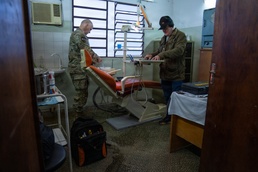
During Amistad 2026, U.S. Air Force biomedical equipment technician Master Sgt. Russell Nick Hires, partnered with Juan Alfonso, a Paraguayan dental equipment specialist, to restore and repair critical dental equipment at health facilities across Paraguay, strengthening the country’s ability to deliver care long after the mission concludes.
Originally assigned to support medical operations at Amistad clinics, Hires spent just one day at his designated site before being asked by Paraguayan health officials to assist Alfonso with a growing list of dental equipment repairs throughout the country. The partnership quickly evolved into a mission of its own.
Together, the two technicians traveled to 11 medical facilities, troubleshooting and repairing dental chairs, compressors, vacuum systems and other essential devices that dentists rely on every day, including restoring equipment at some clinics that had been out of service for more than a year.
“At the clinics, there were small things I could do,” Hires said. “But being able to go around with Alfonso to all these different locations allowed me to have a much bigger impact. If something happens at one of the clinics, I can still help, but traveling and repairing equipment across multiple facilities lets us affect far more patients.”
For Alfonso, the work is a constant challenge. A Paraguayan dental equipment specialist with more than 40 years of experience, he helps maintain approximately 700 dental chairs across nearly 300 dental clinics throughout the country. By the time repairs are completed in one region, new equipment issues are often waiting elsewhere.
The workload means even minor equipment failures can create significant challenges for providers trying to care for patients. Dental chairs depend on four critical systems: water, electricity, air and vacuum suction. If any one of those systems fails, routine procedures can become difficult or impossible to perform.
One of the most common issues the team encountered involved mineral buildup caused by hard water, which can clog internal lines and degrade equipment over time.
“If they had systems that reduced the hardness of the water and regular maintenance procedures to clean the lines, it would significantly extend the life of the equipment,” Hires said.
As they worked side by side, Hires developed a deep respect for Alfonso’s expertise and ability to keep equipment functioning despite limited resources.
“His troubleshooting ability is off the charts,” Hires said. “He’s better than probably 90 percent of the technicians I’ve worked with. The way he thinks through problems and finds solutions is impressive.”
For Hires, seeing the scope of Alfonso’s responsibility firsthand made that expertise even more remarkable. Supporting nearly 700 dental chairs across approximately 300 sites requires not only technical skill but a constant commitment to keeping clinics operational and patients connected to care.
Alfonso said the partnership increased both the speed and reach of their work. “Having Sgt. Hires here has made a big difference,” Alfonso said through a translator. “We have been able to repair more equipment, travel to more locations and restore services faster. When the equipment is working again, clinics can serve their communities the way they were intended to.”
The collaboration also highlighted the value of international partnerships and shared expertise. Language differences occasionally presented challenges, but local translators and health professionals helped bridge communication gaps, allowing repairs to be completed more efficiently.
At one clinic, repairs restored dental chairs that had been operating at reduced capacity, allowing providers to once again deliver a full range of services locally rather than referring patients elsewhere. Dr. Cynthia Uban, a dentist at one of the clinics with a downed dental chair, said the repairs restored equipment that had been limiting the care her team could provide.
“The chairs were not working properly, so we weren’t able to operate at full capacity,” she said through a translator. “In some cases, we had to refer patients to larger hospitals to complete their treatment. Now we can provide more of that care here.”
The restored equipment allows the clinic to serve six to seven dental patients per chair each day while reducing the need for referrals outside the community.
For Hires, the experience demonstrated that readiness and partnership are often built through practical problem-solving. Back home, equipment maintenance follows strict standards and established replacement processes. In Paraguay, technicians frequently rely on innovation, adaptability and resourcefulness to keep critical systems operational.
“There’s a lot more innovation involved,” Hires said. “You have to find ways to make things work and continue supporting patient care. I’ve learned a lot from watching how Alfonso approaches problems.”
While patients may never know who repaired the equipment behind their appointments, the impact is visible every time a dental chair returns to service, a clinic expands its capabilities or a family receives care closer to home.
“There will always be more equipment to repair,” Alfonso said. “But every clinic we help and every chair we restore means more patients can receive care. That’s what makes this work worthwhile.”
<br> <br>