MARCH AIR RESERVE BASE, Calif. — Nestled near Lake Perris and the San Jacinto Wildlife Area and directly beneath the Pacific Flyway, one of North America's busiest migratory corridors, March Air Reserve Base presents a unique challenge for military aviation that differs significantly from urban civilian airports.
For the 163d Attack Wing and 452nd Air Mobility Wing, alongside its mission partners, the Bird/Wildlife Aircraft Strike Hazard program continuously adapts its approach to address the species posing the greatest threat.
"Kestrel season is underway right now, so that's where much of our focus is," said Nicholas Filippelli a USDA Wildlife Biologist. "As migration patterns and species activity change throughout the year, our mitigation tactics change with them. What works for waterfowl isn't necessarily effective for raptors, so we tailor our response to whatever species is creating the greatest risk for strikes.”
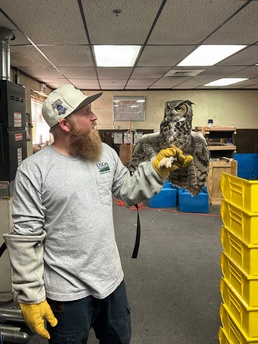
Embedded USDA Wildlife Biologists, Nicholas Filippelli and Erin Olstead, patrol the airfield for wildlife activity. They employ habitat management techniques to reduce hazards before they become threats. Their efforts include dispersing flocks, wildlife depredation, conducting bird activity surveys, disease testing, and coordinating with flying units to provide bird activity heat maps and times to lower strike-incidence opportunities.
One of the program's most successful initiatives has been the management of predatory birds that naturally view the flightline as a prime hunting territory.
During 2025, Wildlife Biologists humanely trapped and relocated 60 birds of prey to mountainous regions away from the base. The relocation effort, combined with targeted wildlife mitigation and habitat management efforts, reduced bird strikes from 55 in 2025 to just eight in 2026, achieving a downward trend compared to the same period last year.
"From a safety perspective, an active BASH program is an absolute necessity for our mission," said Senior Master Sgt. Skyler Swinhart, 163d Attack Wing safety office. "A single aircraft bird strike can have devastating results and lead to mishaps. We rely on a team effort to ensure our airspace is monitored and clear from these hazards. The Safety Office provides the guidance, but our success relies on USDA wildlife biologists to mitigate those hazards, and it is critical to our operational readiness."
According to FAA findings, 82% of strikes occur at or below 1,500 feet above ground level, which coincides with flight training patterns, take-offs, and landings.
Those strikes carry operational consequences and personnel safety concerns, making proactive wildlife management critical.
"Vigilance for birds is essential for MQ-9 crews at March, as a strike risks significant aircraft damage and mandates an immediate mission abort," said Capt. Johnathan Curry, a pilot assigned to the 492nd Attack Squadron. "I've seen crews spend 20 minutes taxiing to the opposite runway to avoid birds on takeoff. Bird control efforts are extremely valuable; without them, grounded or delayed flights would severely hinder the Formal Training Units’ ability to train aircrews."
Team March will always share the airspace with nature, but the BASH program continues to ensure the installation remains a safe environment for air operations and the service members who work there.