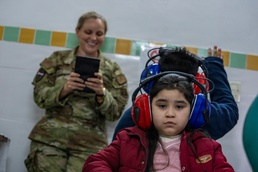
A newly designated federal holiday threatened to disrupt plans for more than 120 student hearing screenings in rural Paraguay, but local health care leaders turned the challenge into an opportunity to expand specialty care to an entire community.
The screenings at Unidad de Salud Familiar Rojas Cañada were scheduled to connect local students with U.S. Air Force audiologists supporting health care engagements during Amistad 2026, a multinational health security cooperation mission. Shortly before the event, however, Paraguay announced Feriados Oficiales, a federal holiday commemorating the signing of the nation’s Constitution, resulting in changes to school and family schedules.
Rather than allowing the day to go unused, clinic director Dr. Cristina López worked with health authorities to keep the clinic open and expand services beyond the original student population.
“Federal holidays will always come around again,” López said through an interpreter. “But an opportunity like this is rare. When I realized some of the students would not be able to attend, I started calling families and telling them to bring everyone. We had specialists here who could help our community, and I was determined not to let that opportunity go to waste.”
As word spread, patients began arriving throughout the day. Families filled the waiting room seeking services that are rarely available in the rural community.
During Amistad 2026, U.S. military medical personnel worked alongside Paraguayan health care professionals to expand access to specialty care while strengthening regional partnerships and medical readiness. At Rojas Cañada, the mission brought audiology services directly to a community where hearing evaluations often require referrals to distant facilities, creating financial and transportation barriers that prevent many patients from receiving care.
The clinic typically sees 15 to 20 patients daily while López balances appointments with community outreach and home visits. During the mission, however, patient volume surged as residents took advantage of hearing and vision screenings available close to home.
The demand reflected a longstanding challenge for many rural patients.
“Most of our patients do not have access to hearing specialists,” López said. “When someone needs an audiology evaluation, they often have to travel long distances, miss work and pay transportation costs. Many simply never go. Having audiologists here brings that care directly to the people who need it.”
For Lt. Col. Johnny Foster, a U.S. Air Force audiologist supporting the mission, the turnout underscored the importance of bringing hearing health care into communities where specialty services are limited. “Hearing loss doesn’t just affect a person’s ears,” Foster said. “It affects relationships, workplace communication and overall engagement with the world around them. Many people adapt to hearing loss without realizing how much they’re missing.”
Originally planned as a student-focused screening event, the effort quickly evolved into a broader community health opportunity. Children received hearing evaluations designed to identify issues that can affect speech, language development and classroom performance, while adults received screenings that could help uncover previously undiagnosed hearing loss.
“A child may appear distracted or struggle in school when the real issue is hearing loss,” López said. “Identifying those problems early can change the course of that child’s education and future.”
Foster said hearing screenings can have impacts that extend far beyond the clinic. “For many people in rural communities, hearing loss develops gradually and often goes unnoticed until it begins affecting daily life,” Foster said. “A screening may only take a few minutes, but it can identify problems that impact communication, education, employment and overall quality of life.”
The clinic conducted dozens of hearing evaluations during the first days of the engagement, helping identify patients who may benefit from follow-on care.
The growing demand for services also created opportunities beyond audiology.
As patient numbers continued to rise, an Air National Guard optometrist who initially volunteered to support the audiology team quickly saw an opportunity to expand services by offering on-site vision screenings, expanding the range of care available to families and helping identify concerns that might otherwise have gone unaddressed.
For López, the overwhelming response highlighted the value of bringing specialty care directly into underserved communities.
“The response showed us how great the need is,” López said. “As soon as people learned hearing and vision screenings were available, they came. Many had been waiting for an opportunity like this.”
Among those receiving evaluations were members of López’s own family, including her mother, brother and children.
“I encouraged my family to participate because I trust the professionals who came here and because I understand the value of these screenings,” López said. “If I believe my patients should take advantage of this opportunity, then my family should too.”
What began as a scheduling obstacle ultimately became one of the clinic’s busiest days of the mission and demonstrated the demand for specialty care in rural Paraguay.
“Plans changed, but the need didn’t,” Foster said. “The community’s response showed just how important access to hearing care is. When the opportunity became available, people came.”
The experience illustrated how partnerships built through Amistad can help expand access to care while strengthening relationships between U.S. and Paraguayan medical professionals.
For López, the impact extends beyond the number of patients seen.
“Hearing affects every part of life,” López said. “It affects how children learn, how adults work and how families communicate with one another. When hearing problems go undetected, the impact reaches far beyond the individual patient.”