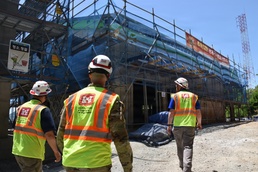
CHINHAE, Republic of Korea — A major infrastructure milestone is just weeks away at Chinhae Naval Base as the massive project to relocate and modernize the installation's water treatment plant enters its final phase. With the official turnover scheduled for late June 2026, this strategically important project is moving rapidly toward the finish line.
For the U.S. Army Corps of Engineers – Far East District team, the project represents more than just concrete and pipelines; it reflects an enduring commitment to the community.
"Utility infrastructure often operates quietly in the background, yet it is the critical lifeline that ensures the health, safety, and readiness of our base communities," said Eliot Bignell, project manager, USACE FED. He noted that delivering these complex projects to guarantee clean drinking water for the warfighter brings a profound sense of professional pride.
The relocation simultaneously tackles two critical issues: physical security and operational resilience.
"The existing water treatment plant and raw water storage tanks were located in a flood zone and an unsecured area very close to the Main Gate,” Bignell said. This proximity to the base perimeter failed to meet force protection setbacks and modernization guidelines, which influenced the relocation."
The new facility sits at a higher elevation next to the base's existing drinking water storage tanks, allowing water to flow more efficiently through gravity. This new location provides a secure, reliable and resilient source of clean drinking water for service members and families stationed at Chinhae.
Bignell noted that the upgraded system greatly simplifies water distribution. A new 250-millimeter (10-inch) fill line replaces the old 100-millimeter (4-inch) line, drastically reducing the number of valves and pumps previously needed to push water uphill.
Additionally, the project integrates four existing raw water wells with the new plant. Because the new facility is located about 500 meters further away and 100 meters higher than the original site, the wells were upgraded with high-capacity pumps to handle the extra distance and elevation.
"Pumping water across an 860-meter pipeline route with a 100-meter vertical climb introduced significant hydraulic head requirements,” Bignell said. "It also created extreme risks of 'water hammer'—or hydraulic shock—that could damage the infrastructure."
To overcome these engineering challenges, teams paired the new high-capacity pumps with variable frequency drives to maintain constant, steady pressure. They also added protective features to prevent damaging pressure spikes and safely release trapped air from the pipeline.
Remarkably, executing these massive upgrades has caused zero disruption to daily life at Chinhae. Bignell shared that the team successfully maintained the base's 50,000 gallons-per-day water supply by building the new facility completely independent of the old one. By using entirely new equipment rather than salvaging legacy parts, the original plant remained fully operational throughout construction.
A pre-final inspection is scheduled for this week, paving the way for the official turnover to the U.S. Navy by the end of the month. Originally awarded by the Republic of Korea Ministry of National Defense – Defense Installations Agency (MND–DIA), the project is wrapping up right on schedule.
"When the facility turns over, the primary benefit to families on base will be guaranteed water security, safety, and reliability," Bignell said. "The system is no longer at risk of flooding or perimeter security threats, and it incorporates a highly automated, modernized disinfection system."
Ultimately, the successful delivery of this state-of-the-art facility underscores the strength of the ROK-U.S. Alliance. It stands as a prime example of close collaboration that will support and protect the Chinhae community for decades to come.