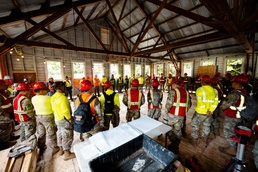
ORICK, Calif. – As thick fog drifted through the towering redwoods and birdsong filled the forest, Master Sgt. Amber Johnson, 163d Civil Engineer Squadron, California Air National Guard, broke the morning calm with a familiar command: “Everybody gear up!” The call gathered 55 Airmen from the 210th Rapid Engineer Deployable Heavy Operational Repair Squadron Engineers (RED HORSE), New Mexico Air National Guard, for accountability before another day of construction, a routine Johnson has led each morning for the past three weeks.
Johnson and Capt. Taylor Fisher, with the 200th RED HORSE Squadron, Ohio Air National Guard, are in charge of the Redwoods Innovative Readiness Program (IRT) which is a multi-organizational effort between the Air National Guard, Army National Guard, Navy Reserve, Air Force Reserve Command, the Yurok Tribe Construction Corp., and the National Park Service at the Redwood National Park.
The renovation of the 90-year-old Prairie Creek Fish Hatchery into a community educational center will honor and showcase the site's historic significance. This two-month project, which started June 1 and plans to finish Sept. 2, is one of many projects under the IRT program.
The IRT program is a Department of War military training opportunity, exclusive to the United States and its territories, that delivers joint training to increase deployment readiness. Through the DoW’s IRT program, military units gain valuable hands-on experience while providing critical services and lasting support to communities across the country.
“We go through and make sure that our service members are taken care of,” said Johnson. “But it’s a group effort on our side to get the logistics ready, the park’s side to get the construction ready and the Yurok Tribe lets us know the type of work we will be doing.”
Johnson and Fischer have the rigorous job to coordinate and ensure the mission stays on track with the two-week rotations of Soldiers, Sailors and Airmen being mobilized to undertake construction of the hatchery.
Daily responsibilities critical to mission success include ensuring food services are delivered efficiently, adjusting operations to keep projects on schedule, preparing after-action reports that document events, lessons learned, and areas for improvement, documenting training tasks for cross-branch service members, and coordinating with the Yurok Tribe Construction Corp. and the National Park Service to ensure staffing, construction progress, and that project deadlines remain on track.
“Really, my job is a liaison,” says Johnson. “Every rotation you end up doing better because you don't know what you don’t know; We want to make sure that we continue improving. It’s being able to pivot when necessary and not stress on the things you can’t control, but create new alternatives.”
With a limited time frame for extensive multi-trade renovation, coordination and cross-branch collaboration are paramount to the Redwood IRT’s success. So far, Johnson and Fischer coordinated and processed service members in the U.S. Navy Reserves Construction Battalion 22 and 210th RED HORSE Squadron, but have plans to rotate in the Army Reserves 244th Engineer Battalion, 188th, Arkansas Air National Guard, 145th, North Carolina Air National Guard, 161st, Arizona Air National Guard, 301st, Air Force Reserve, and 419th, Air Force Reserve, CE Squadrons.
“We couldn’t have asked for better community partners on this project,” says Fischer. “Working with Johnson has been great, she handles the enlisted side, and I handle the officer side… I think we both have our own talents, especially her being full-time [Active Guard Reserve], and then me being able to manage more of the engineering side.”
With long days of construction underway, Johnson and her team keep in mind their goal: converting the Prairie Creek Fish Hatchery into a serviceable educational center to support the local community.
“Once it’s completed…people will be able to learn about the hatchery, what it was made for, what its purpose was and why they no longer needed it,” said Johnson. “I love that it’s going to have this educational piece that's going to continue for generations, and it’s also going to keep this facility here to have a real purpose.”
For Johnson, the project represents more than a construction mission. Through her leadership, coordination and commitment to both the training mission and the local community, she exemplifies the standard of excellence that defines the 163d Attack Wing. By developing joint-service readiness and helping to preserve a historic landmark for future generations, Johnson and her team demonstrate how mission success and community impact can go hand in hand.