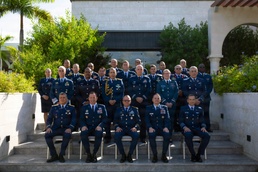
PUNTA CANA, Dominican Republic — Air chiefs and senior military leaders representing air forces from 19 nations across the Western Hemisphere gathered in the Dominican Republic June 15-19 for the 66th annual Conference of the American Air Chiefs (CONJEFAMER), reinforcing a shared commitment to regional security, cooperation and interoperability through the System of Cooperation Among the American Air Forces (SICOFAA).
The annual conference serves as SICOFAA's premier forum for member nations to exchange perspectives, address shared challenges and provide strategic guidance for the organization's future efforts. This year's conference concluded with participating air chiefs approving a new strategic focus on airspace control and efforts to combat illicit air activity, marking the organization's latest effort to address evolving security challenges in the region.
During the opening ceremony, U.S. Air Force Vice Chief of Staff Gen. John D. Lamontagne highlighted the importance of multinational partnerships.
"The opportunities for our air forces to train together and build interoperability are essential for the readiness of the United States Air Force," said Lamontagne.
Founded in 1961, SICOFAA has evolved into a multinational organization focused on fostering cooperation among American air forces through common doctrine, professional exchanges, tabletop exercises and operational training events. The organization currently includes 21 active member nations and provides a framework for collaboration while preserving the sovereignty of participating countries.
According to U.S. Air Force Col. David Bewley, SICOFAA secretary general, face-to-face engagement remains one of the organization's most valuable strengths.
"You can't replace personal relationships," said Bewley. "Knowing and shaking the hand of your counterpart, looking them in the eye and hearing their priorities and concerns helps you understand that their priorities and concerns are also your own."
Those relationships are reinforced through recurring engagements, exercises and professional exchanges designed to improve interoperability before real-world events occur. Earlier this year, member nations participated in COOPERACION XI, SICOFAA's multinational humanitarian assistance and disaster relief exercise hosted by Brazil, which put common training and doctrine into practice.
Lamontagne also referenced regional efforts to address transnational threats, including cooperation among some partner nations to degrade and disrupt illicit activity.
"We are eager to work with the members of the Americas Counter Cartel Coalition who have committed to defeating the scourge of narco-terrorism because, together, we can do more," Lamontagne said.
One of the conference's most significant outcomes was the approval of a new strategic focus area aimed at strengthening regional efforts to secure sovereign airspace and address emerging transnational threats.
"Securing air sovereignty is a shared imperative of the hemisphere," Lamontagne said, emphasizing the importance of information sharing and collective action among partner nations as they confront evolving regional security challenges.
The initiative will be incorporated into SICOFAA's next strategic plan and serve as a third line of effort alongside humanitarian assistance and disaster relief and institutional relationship-building, reflecting SICOFAA's ability to adapt to emerging challenges while maintaining its longstanding commitment to cooperation and mutual support.
"We leave today with a SICOFAA that is more robust, interoperable and prepared to confront common challenges, humanitarian emergencies and provide timely assistance to our populations," said Maj. Gen. Floreal T. Suárez Martínez, commanding general of the Dominican Republic air force and CONJEFAMER president.
The conference concluded with a ceremonial transfer of the SICOFAA bell from the Dominican Republic to Peru, symbolizing Peru's selection as the next host nation and the beginning of preparations for the organization's next annual cycle.
"We have reaffirmed that the airspace that separates us is, in reality, what unites us most," said Suárez Martínez.
With a new strategic focus on airspace control, participating nations concluded the conference with a roadmap intended to strengthen cooperation and address emerging challenges throughout the Western Hemisphere.