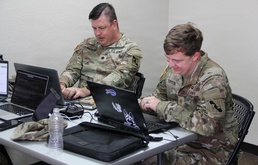
75th USARIC Fleet Assessment Team establishes equipment benchmarks that measure performance during OSJ 26
CAMP SHELBY, Miss. — Equipment utilization across future battlefields is a subject of great interest to the U.S. Army, but planning for the future requires evaluation today. The 75th U.S. Army Reserve Innovation Command’s involvement during Operations Sentinel Justice 26 included their Fleet Assessment Team addressing that exact concern, establishing performance benchmarks that impact exercises of tomorrow.
Their mission: gather real‑world performance data from Army Reserve rotational training units using military equipment in realistic, contested training environments.
The Fleet Assessment Team included five Soldiers from the Army Sustainment Command’s Army Reserve Element and an additional four civilians: two from the U.S. Army Tank-Automotive and Armaments Command and two from the U.S. Army Communications-Electronics Command. The team’s specialty is understanding how Army equipment performs across its entire lifecycle—from fielding to long‑term sustainment. During OSJ 26, that expertise was applied to a wide range of systems.
“Our job is to help Soldiers and maintainers understand why their equipment failed, how to fix it, and how to keep it from failing again,” said Lt. Col. David Yarwood, officer in charge, Fleet Assessment Team, Army Sustainment Command – Army Reserve Element, 75th USARIC, who led the fleet assessment effort during the exercise. “We want them to have all the equipment they need to train to standard, to train how they fight and fight to win.”
The Fleet Assessment Team served as the connective tissue between the training audience, consisting of MP units, logistics units and command elements, and the Logistics Assistance Representatives. The Fleet Assessment Team leveraged the LARS and Power Business Intelligence dashboards to identify trends and areas of concern with critical equipment, including power and environmental systems, lower tactical infrastructure communication equipment, combat support systems, and Soldier chemical and biological equipment.
OSJ 26 provided the ideal environment for that mission: a large-scale, multi-state exercise with more than 12,000 Army Reserve Soldiers training across complex, multi-domain scenarios.
The Fleet Assessment Team focused on evaluating equipment, including:
The Fleet Assessment Team’s presence at OSJ 26 reflects a broader shift in how the Army Reserve utilizes LARs. Previously, USAR employed LARs in support of rotations at the Joint Reserve Training Center and National Training Center for Active Duty and National Guard brigade-level missions. OSJ 26 represents the first time Army Reserve Soldiers have provided Fleet Assessment Team capabilities to a COMPO 3 exercise.
“Army Reserve, National Guard, and Active Duty all use the same equipment, and we see similar issues across the entire force. We’re just glad to be able to help Soldiers wherever they need it,” said Michael Clark, a TACOM LAR with the Fleet Assessment Team.
Their work extended beyond simple observation. The team conducted structured interviews, collected user feedback, and documented performance issues in real time. Fleet Assessment also coordinated with assigned LARs to troubleshoot problems, validate fixes, and ensure that as much equipment as possible remained operational throughout the exercise.
“Our goal is to arm commanders with the best information possible about what goes wrong and why from a maintenance perspective,” said Capt. Alan Rhodes, fleet assessment officer, ASC-ARE, 75th USARIC. “What we learned here will help the Army grow and maintain operational readiness, which is critical to ensure the success of any real-world mission or training exercise.”
For the 75th USARIC, the exercise reinforced the command’s role as a catalyst for innovation across the Army Reserve and the total force; and for the Fleet Assessment Team, it demonstrated the value of meeting Soldiers where they train—capturing insights that only emerge in the dirt, heat, and pressure of real-world operations. In total, the Fleet Assessment Team impacted over 500 pieces of CECOM and TACOM managed equipment and provided over 40 hours of training to more than 50 Soldiers.
As OSJ 26 concludes, the Fleet Assessment team departs with a wealth of data, user insights, and recommendations that will provide the training audience with critical maintenance takeaways to improve their operational readiness for future exercises. These takeaways include recommendations on how to plan, prepare, and execute maintenance leading up to and during any mission or training event.