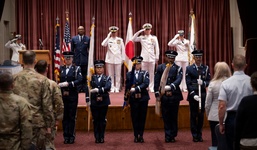
YOKOTA AIR BASE, Japan -- U.S. Coast Guard Activities Far East welcomed a new commander during a change of command ceremony at Yokota Air Base, Japan, June 11. The ceremony marked the transfer of leadership from Capt. James Suffern to Capt. Kira Moody, ensuring continuity of operations across the command’s expansive area of responsibility throughout the Indo-Pacific.
Presided over by Rear Adm. Sean Regan, commander of U.S. Coast Guard Oceania District, the ceremony featured a time-honored maritime tradition where the assembled crew witnessed the formal reading of official orders and the transfer of authority and responsibility from one commander to the next.
The U.S. Coast Guard has maintained a continuous presence in the Far East since 1947, building a decades-long legacy of maritime safety, security and international partnership throughout the region. Headquartered at Yokota Air Base, Japan, FEACT serves as the U.S. Coast Guard’s primary operational command in the Indo-Pacific region and is one of only two U.S. Coast Guard commands located internationally.
“Our mission is to provide maritime safety and security services that promote regional stability and maintain an uninterrupted marine transportation system,” Moody said.
While the U.S. Coast Guard is often associated with domestic missions in American waters, FEACT performs a unique international role from its headquarters in Japan. Working alongside the Japan Coast Guard and other regional maritime partners, the command helps strengthen maritime safety standards, improve port security and support the uninterrupted flow of commerce throughout the Indo-Pacific.
“Our primary focus at Activities Far East is protecting the safety of U.S. mariners and the security of our nation’s commerce,” Moody said. “Because more than half of all global shipping transits through this region, our permanent presence here helps keep U.S. trade and the global supply chain moving safely and securely.”
The command carries out these responsibilities across approximately 48 million square miles, stretching from west of the Hawaiian Islands to the India-Pakistan border. FEACT also works with more than 40 partner nations to strengthen port security, support maritime commerce, and promote regional stability throughout the region.
Beyond maritime commerce, Moody emphasized the command’s role in supporting broader U.S. military operations. “The U.S. Navy and Military Sealift Command rely heavily on the U.S. commercial fleet to operate in this theater,” Moody said. “By ensuring these vessels meet the highest safety and compliance standards, our work directly enables the strategic mobility of the Joint Force.” As the new commander assumes leadership, Moody said her priorities include modernizing the command’s expertise to keep pace with emerging maritime technologies, ensuring the readiness of commercial logistics vessels and strengthening relationships with partner nations throughout the region.
“Strong partnerships are essential to maritime security,” Moody said. “By working closely with our allies and partners, we can promote safe, secure and efficient maritime commerce while addressing the challenges facing the Indo-Pacific maritime community.”