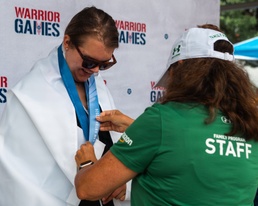
SAN ANTONIO, Texas – June 20, 2026 – For Capt. Vanessa Munro, arriving at the 2026 Warrior Games already feels like a victory. Before the first event begins and before scores are posted, Munro’s presence with Team Army is a reminder of how far recovery can reach when determination, support and purpose come together.
Munro’s victory is being part of a team again. After a tragic car accident in 2023 resulted in a severe traumatic brain injury, brain surgery and an extended coma, the road back has included months of hospitalization, intensive rehabilitation and daily work to regain strength, confidence and independence.
Now competing with Team Army, Munro is reconnecting with something she’s missed: the camaraderie, joking, banter and shared support that come with being part of a team.
Munro’s mother, Heidi, shared that the Warrior Games has given her daughter an opportunity to be surrounded by athletes and coaches who see her.
“She loves how everyone supports one another and how people treat her as capable, not disabled,” Heidi said. Munro was commissioned as a Field Artillery officer in 2018 after completing ROTC at the University of Washington. After four years in her branch, she was selected for the Army’s Interservice Physician Assistant Program. Before the accident, she was also an elite athlete and Ironman competitor. Her Soldiers often called her “The Iron Ma’am.” After the accident, a new nickname emerged.
Heidi shared that as friends came in and out of Munro’s inpatient room with Starbucks, sushi, cute clothes and colorful head coverings, they helped bring light into a difficult season. They bedazzled her wheelchair and walker, decorated her room and made sure her nails were painted. Before long, Munro became known as “The Bougie TBI Girl.”
The motto she carries now captures both parts of her story: “From Iron Ma’am to Bougie TBI Girl: Never Give Up.” For Heidi and Kailee, Munro’s childhood best friend and caregiver, that motto is more than a phrase. It reflects how Munro has approached recovery from the beginning.
Even in a semi-conscious state, Munro didn’t want to be seen as disabled. Once she was able to walk, she refused to use the wheelchair. Then she refused the walker. About six months after the accident, she began walking a mile a day. The pace was slow, and the walks required breaks, but Munro kept asking to go.
On days when Heidi and Kailee were exhausted, Munro would look at them and say, “Outside time.” From the beginning, they said, she refused to give up.
Adaptive sports became another part of her recovery. Munro’s first adaptive sport was skiing, which made her feel alive and free again. Her confidence grew after that first ski trip. Swimming came next, and once she connected with an adaptive swim coach, the pool became a place where she could focus on what she could do rather than what she couldn’t do.
The adaptive triathlon later reintroduced Munro to competition, wearing a uniform, supporting others and being supported by a team.
Participation in various sports activities plus the Warrior Games, has helped Munro reconnect with the athlete she was before her injury while continuing to discover who she is now.
Kailee said what people see during competition is only part of the story.
“What I’ve witnessed isn’t just physical recovery, it’s resilience,” Kailee said. “I’ve watched Vanessa choose to keep showing up when it would have been easier not to. I’ve watched her rebuild pieces of herself one day at a time. The Warrior Games are incredible, but it’s just the visible part of a recovery that’s been happening every single day for years.”
For Heidi, watching Munro compete has been deeply emotional. Two years ago, doctors told the family Munro would never walk or talk again. Seeing her at the Warrior Games just 30 months into recovery has filled her with hope.
“The real work has taken place in countless therapy sessions, difficult mornings, bouts of depression, setbacks, and small victories that most people never see,” Heidi said.
One of the most powerful moments came on the track.
“I cried at the track,” Heidi said. “I watch her struggle to walk every day, always afraid she’ll trip over her own foot. I’ve never seen her run, so to watch her run the 200, with obvious difficulty and exhaustion, and to finish it to a standing ovation and the entire crowd cheering for her, that was the highlight of Warrior Games for me.”
When Munro was shown videos of herself walking for the first time after her injury and asked what she thought about herself from the beginning of recovery until now, she chose three words: “Surprised. Excited. Inspired.” For Kailee, the hope is that Munro sees what those closest to her have seen all along.
“Recovery hasn’t been about finding her way back to the exact person she was before,” Kailee said. “It’s been about discovering who she is now, the same fierce, determined, funny, stubborn and compassionate person who inspired people before the accident.”
Kailee said Munro’s path looks different today, but her strength has never left her.
For Munro, the journey from Iron Ma’am to Bougie TBI Girl isn’t about becoming less than she was before. It’s about continuing to move forward, reclaiming pieces of herself and proving, one step and one competition at a time, that “never give up” is more than a motto.
It’s how she got here.
Editor’s note: Because Munro is still in recovery, some responses and additional context for this story were provided through her mother, Heidi, and her childhood best friend and caregiver, Kailee.