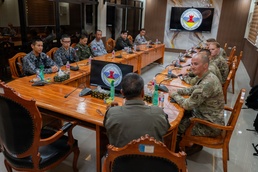
CLARK AIR BASE, Philippines – Operating at the forefront of the U.S. Air Force’s deployment evolution, the 21st Air Task Force officially transitioned into an Air Expeditionary Wing to project airpower and integrate combat support during Exercise Balikatan 2026, April 6 to May 8.
Set against the backdrop of the 75th anniversary of the U.S.-Philippine Mutual Defense Treaty, the 21st AEW employed a modular, scalable "Unit of Action" out of Clark Air Base. By providing centralized command and distributed execution, the wing preserved critical decision space for commanders operating alongside partner nations in the Indo-Pacific.
“Exercises like Balikatan strengthen interoperability and reinforce our collective ability to operate together in support of regional stability,” said U.S. Air Force Col. Paul Julian, 21st AEW commander. “It’s about building readiness and the ability to respond side by side when needed.”
The backbone of this deployment model is the 21st Combat Air Base Squadron, a deliberately teamed element that established the Base Operating Support Integrator footprint. This structure allowed designated joint and combined forces to rapidly conduct reception, staging, onward movement and integration upon arrival.
“The 21st Combat Air Base Squadron was designed to adapt to nearly any operational environment,” said Lt. Col. Nathaniel White, 21st CABS commander. “Throughout Balikatan 2026, our Airmen demonstrated flexibility and found ways to remain operationally relevant while working alongside Philippine and Japanese partners across a variety of mission areas.”
Putting the concepts of Agile Combat Employment into practice, the squadron executed airfield operation, logistics, damage repair, emergency response and munitions support. They also conducted extensive subject-matter expert exchanges with their Philippine Air Force counterparts to refine shared tactics and improve operational coordination.
“We’ve also had opportunities to engage regarding munitions, general civil engineering, entomology, vehicle maintenance, logistics, firefighting and airfield operations,” said White. “Overall, we’ve found many opportunities to share and learn from all the partners participating in BK26.”
Throughout the exercise, Airmen worked in tandem with their Philippine Air Force partners to install and maintain a mobile aircraft arresting system necessary to receive fighter aircraft. In totality, the 21st CABS facilitated the generation of 154 out of 162 sorties planned, a 95% generation rate which leveraged geography to extend deterrence, accelerated alliances and partnerships, and demonstrated the lethality of the platforms available over a three-week period.
While sortie generation measured operational effectiveness, the 21 AEW’s contributions also helped make possible several milestone events, including the first live-fire missions conducted during a Balikatan exercise within the Philippines.
“Our team found a liquid nitrogen cart ensuring the 2nd Special Operations Squadron could execute live firing missions in support of BK26,” said White. “Actions such as these are ultimately what enabled success.”
Beyond the flightline, the 21st AEW prioritized the human element of interoperability. Building trust and resilience with local communities proved just as critical as hardware and logistics.
“As the sole chaplain for the wing, my role quickly expanded beyond supporting the spiritual well-being of our Airmen to helping build relationships with Philippine Air Force leaders and local communities,” said U.S. Air Force Capt. Joseph Jun, 21st AEW chaplain. “By listening first and working alongside our Philippine counterparts, we were able to better understand local needs and strengthen humanitarian and partnership efforts together.”
Jun attended meetings with leaders from 540th Air Base Group, 600th Air Base Group and the chaplains of the Philippine Air Force to establish connections, survey local needs and organize potential community outreach events. Throughout 21st AEW’s time in the Philippines, Jun planned and executed vital engagements to unlock bilateral access to synchronize interoperability between the forces.
“These endeavors were intended to secure critical support contacts to optimize unit readiness, streamlining administrative processes,” said Jun. “Building strong relational bridges with the Philippine Air Force unlocks opportunities for future integration and trust between neighboring forces.”
These combined efforts fostered mutual understanding among the more than 17,000 participating personnel from the Philippines, United States, Australia, Japan, Canada, France and New Zealand and helped to support the largest iteration of Balikatan to date.
Through agile combat employment, integrated operations and close coordination with allied partners, the 21st AEW and the 21st CABS executed their role as a “Unit of Action” and strengthened interoperability, enhanced readiness and projected combat capability throughout BK26.
Balikatan is a longstanding annual exercise between the Armed Forces of the Philippines and the U.S. military that demonstrates the strength of our alliance, enhances our capable combined force and underscores our commitment to regional security and stability.