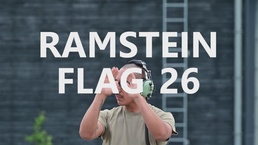
PIRKKALA AIR BASE, Finland -- The 48th Fighter Wing concluded its participation in the NATO Allied Air Command-led Exercise Ramstein Flag 26 June 18, demonstrating its ability to integrate with NATO partners and Allied air forces to generate combat airpower across the European theater.
Held from northern Norway to southern Spain, Ramstein Flag 26 brought together personnel from 18 nations, including 17 participating air forces, operating from 20 locations across Europe. The exercise focused on integrated air and missile defense, information and intelligence sharing, counter anti-access/area denial operations and Agile Combat Employment.
For Airmen from RAF Lakenheath, the exercise provided an opportunity to strengthen interoperability with NATO members while validating the wing's ability to conduct Agile Combat Employment to project immense military air combat strength from dispersed locations.
Throughout the exercise, Liberty Wing Airmen flew more than 120 sorties in 12 F-35A Lightning II’s and accumulated more than 285 flight hours. Generating that level of tactical air capability required seamless coordination among U.S. Air Force operations, maintenance and support personnel, as well as strong partnerships with the U.S. Marines and Allied forces from the Finnish air force and beyond.
“Being in Finland has been amazing, through the culture that we’re able to experience to seeing how they do their jobs,” said Staff Sgt. Richard Johnson, 493rd Fighter Generation Squadron dedicated crew chief. "Something that’s really stood out to me is just the way they operate…It goes both ways - we teach them and they teach us.”
Maintainers and support personnel from the 48th FW, Marine Air Control Squadron 2, Marine Wing Support Squadron 272 and Satakunta Air Wing played a critical role in sustaining aircraft readiness and generating the high sortie rate required throughout the demanding operational tempo of the exercise. That coordination was evident from the flightline to the air, where Airmen, Marines and their NATO counterparts operated as a cohesive force, enabling aircrews to focus on multinational integration with joint service and NATO member aircraft while refining tactics in complex operational scenarios.
“Anytime you get a chance to integrate with different nations and Allied partners, there's always a ton of things to learn,” said Maj. John Bynum, 493rd Fighter Squadron assistant director of operations and Ramstein Flag 26 operations project officer. “We all have different capabilities across the force between F-18s, F-16s, F-35 Strike Eagles, Raptors…Seeing how that coalesces in the airspace and then turns into tactics and then ultimately creates effects, that's probably the best part.”
Ramstein Flag 26 also provided the 48th FW with the opportunity to further validate Agile Combat Employment concepts. While aircrews conducted advanced live-fly training, planning and executing suppression and destruction of enemy air defenses from geographically dispersed locations, Airmen from a myriad of different career fields took to the flightline to launch, hot-pit refuel and recover U.S. Air Force F-35A Lightning IIs and Royal Navy F-35B Lightning IIs alongside U.S. Marines and Finnish air force personnel, proving the tactical Mission Ready Airmen concept on both a joint and international scale.
By operating alongside other U.S. services and Allied forces throughout Ramstein Flag 2026, the 48th Fighter Wing increased NATO Alliance cohesion and demonstrated the organization’s ability to rapidly generate and employ combat airpower in support of collective defense across the Euro-Atlantic region.
“Our roster is deep,” said Chief Master Sgt. Paul Fletcher, 493rd FGS senior enlisted leader, about the 48th FW’s ability to bolster NATO objectives. “Our bench is deep. We have super talented people who are energized and ready. No matter what’s thrown at us, the 48th Fighter Wing will get the job done.”