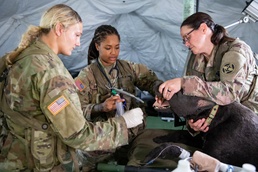
CAMP SHELBY, Miss. — U.S. Army Reserve Soldiers throughout the Pinellas Park, Florida-based Army Reserve Medical Command (AR-MEDCOM) and the San Antonio-based Medical Readiness and Training Command (MRTC) trained alongside more than 10,000 U.S. Army Reserve Soldiers, in tandem with other branches of the U.S. military as well as British and Canadian forces, during Operation Sentinel Justice and Global Medic at Camp Shelby, Mississippi, and Camp Beauregard, Louisiana, June 6–21, 2026.
Both Operation Sentinel Justice and Global Medic this year created one of the Army Reserve medical enterprise’s largest opportunities to simultaneously execute a real-world medical mission while validating medical units for future operational requirements.
The result was a unique environment where medical units not only delivered real-world medical capabilities but also trained and were evaluated under conditions designed to replicate the complexity of large-scale combat and mobilization operations.
Unlike traditional training exercises, Operation Sentinel Justice combines mission execution with readiness validation. Medical personnel perform their operational duties while experienced observer, coach and trainers assess unit performance against deployment standards, providing commanders with an accurate measure of readiness.
Army Reserve Col. Bryan Green, commander of the 7307th Medical Exercise Support Battalion, said the success of the mission depends on the complementary roles performed by AR-MEDCOM and MRTC.
“AR-MEDCOM and MRTC exemplify their unique roles by dividing the medical mission into two complementary lanes,” Green said. “AR-MEDCOM delivers real-world medical capabilities, while MRTC delivers high-fidelity medical training and exercise support. Together, they create a seamless pipeline from training to operational execution that supports both large-scale exercises like Global Medic and real-world missions such as Operation Sentinel Justice.”
The partnership allows Soldiers to gain valuable operational experience while leaders assess their ability to perform in demanding environments. As medical units execute their mission requirements, MRTC personnel provide oversight, coaching and evaluation to ensure units are capable of deploying and supporting future operations.
“MRTC’s primary goal is to prepare, evaluate and validate medical units so that they are able to adapt and execute in support of large-scale combat operations,” Green said. “We strive to ensure rotational training units are trained to deployment standards and not just annual training standards.”
Army Reserve Col. Michael Alvis, assigned to the 7304th Medical Training Support Battalion and serving as a senior observer, coach and trainer during the operation, said Operation Sentinel Justice provides an opportunity rarely replicated during routine training events.
“Operation Sentinel Justice brings units together in one location with multi-component and multi-support assets working together as a team,” Alvis said. “The significance of this training is that Soldiers take the individual tasks they have practiced throughout the year and combine them into collective tasks that require coordination, collaboration and synchronization.”
Green said the exercise places field hospitals, medical logistics organizations and other medical units in a shared operational environment where they must execute mission requirements while integrating medical support with sustainment and maneuver operations. According to Green, the conditions are designed to replicate the complexity Army Reserve medical units may encounter during future deployments.
Alvis said hospital centers, field hospitals and medical logistics organizations train collectively during Operation Sentinel Justice, requiring coordination, communication and synchronization across multiple medical functions. He said the integrated environment allows observer, coach and trainers to evaluate how effectively units accomplish their assigned missions while operating alongside other medical organizations.
Planning for an operation of this scale begins more than a year in advance and relies on experienced observer, coach and trainers from across the Army Reserve Medical Enterprise. He said their operational and leadership experience helps provide rotational training units with realistic feedback and readiness assessments, said Alvis. Alvis said those evaluations help commanders understand unit strengths and identify areas for improvement before future operational missions, supporting MRTC’s mission to prepare and validate Army Reserve medical units for deployment requirements.
Alvis emphasized that medical units serve an essential role in supporting both maneuver and sustainment operations by ensuring wounded Soldiers receive timely medical care and treatment.
“Our responsibility is helping commanders accomplish their mission by providing the medical capability needed to care for wounded Soldiers,” Alvis said. “That allows commanders to focus on their operational objectives knowing there is a medical team prepared to support their Soldiers when needed.”
Green said medical units play a key role in supporting operational forces by providing commanders with the medical capability needed to care for wounded Soldiers. He said that capability enables commanders to focus on mission objectives while ensuring medical support remains available throughout the operational environment.
Green noted that Operation Sentinel Justice remains one of the few opportunities for Army Reserve medical organizations to operate at the scale required for modern military operations.
“Operation Sentinel Justice is one of the only large-scale real-world missions that forces the Army Reserve, especially the medical enterprise, to operate at the scale, speed and complexity required for both large-scale combat operations and large-scale mobilization operations,” Green said.
Alvis also noted that Operation Sentinel Justice highlights the contributions of Army Reserve Soldiers who balance military service with civilian careers. He said the exercise gives Soldiers an opportunity to apply individual skills in a collective environment while working alongside other units across the Army Reserve Medical Enterprise.
The partnership between AR-MEDCOM and MRTC brings together operational medical support and readiness validation in a single environment. He said the approach enables Soldiers to gain practical experience while MRTC observer, coach and trainers evaluate unit performance against deployment standards, said Green.
Green said the combined approach enables Soldiers to validate readiness in a realistic environment while strengthening coordination between medical organizations across the force.
For the thousands of Soldiers participating across the exercise, Green said the mission represents an opportunity to validate readiness, strengthen partnerships and ensure Army Reserve medical forces remain prepared to provide lifesaving support whenever and wherever the nation calls.