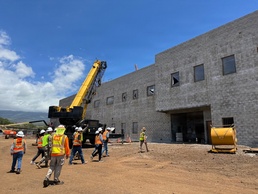
MAUI, Hawaii — The Space Base Delta 1 commander, U.S. Space Force Col. Kenneth Klock conducted a site visit to Maui June 8-9 to meet with leadership from the 15th Space Surveillance Squadron, assess infrastructure requirements, and observe mission operations at the Maui Space Surveillance Complex.
Headquartered at Peterson Space Force Base, Colorado, SBD 1 provides installation support and real property management for Space Force operations on Maui, including facilities supporting the operations of 15th SPSS and research for the Air Force Research Laboratory.
The visit began with a mission briefing from 15th SPSS leadership, led by Lt. Col. Douglas Thornton, 15th SPSS commander. As a blended unit under Mission Delta 2, the squadron executes both research and operations for U.S. Combat Forces Command's mission of providing Space Domain Awareness capabilities to the joint force. Space Domain Awareness provides military leaders and decision-makers with a comprehensive understanding of the space environment, helping protect satellites and space-based capabilities that support communications, navigation, weather forecasting, and national security operations relied upon every day.
"Visits like this provide an opportunity to showcase the operational requirements, infrastructure needs, and unique challenges associated with executing the mission from a geographically separated location," said Thornton. "They also help ensure leadership understands the resources and support required to sustain mission success on Maui."
During the briefing, squadron leaders discussed current operations, future mission requirements, and real property support needs. Topics included base contracts, information technology, logistics, and civil engineering requirements necessary to sustain mission capabilities on Maui. Klock also received updates on construction projects designed to sustain existing mission operations and support long-term mission requirements.
A key stop during the visit was the military construction site in Kihei that will serve as the squadron’s headquarters. Once completed, the government-owned facility will consolidate 15th SPSS personnel and operations, currently spread across multiple leased locations on Maui, into a single secure location supporting existing operations and research and development efforts. SBD 1 will also provide real property management for a portion of the facility.
Construction is progressing following initial groundbreaking activities that began in 2025. By centralizing these operations, the facility is expected to improve operational efficiency, reduce reliance on leased commercial space, and provide a more secure location for day-to-day operations.
As more satellites – both domestic, foreign, commercial and military – are placed in orbit over the Pacific Theater and the Hawaiian Island chain, the Space Force must to continue to develop space domain awareness capability to ensure resilience of U.S. and allied satellite constellations and maintain freedom of action in space. This includes the development of essential facilities and other infrastructure needs.
"Mission success depends on more than the capabilities employed here every day,” said Klock. “Behind every operation is a network of reliable facilities, utilities, contracts, and installation support that makes the work possible. Seeing those requirements firsthand helps us better understand where we need to focus on our efforts and ensure we’re providing the resources necessary to support the team here on Maui.”
Following the Kihei site visit, the command team traveled to the Maui Space Surveillance Complex atop Haleakalā. Operated by the 15th SPSS, the complex supports AFRL research and space domain awareness operations. Located more than 10,000 feet above sea level, the site benefits from some of the world's premier astronomical viewing conditions, enabling the collection of critical observations used to track and characterize objects in space. The altitude and geographic positioning of Haleakalā makes no location in the world better to obtain data vital to the Space Force’s space domain awareness mission.
Klock received updates on the ongoing culturally guided remediation efforts following the lightning-caused fuel spill in 2023. Leadership discussed progress under the site's four-phase remediation plan, which is currently in phases three and four. Phase three focuses on active remediation efforts, including onsite bioventing treatment systems designed to treat affected soil while preventing the removal of soil from the project site. Phase four focuses on developing containment measures intended to prevent possible future releases from impacting surrounding soil and environmental resources. Officials also discussed the long-term monitoring and assessment efforts that will continue as remediation activities progress toward established environmental goals.
Lastly, leadership observed operations of the Advanced Electro-Optical System, a 3.6-meter telescope and the Department of War’s largest aperture telescope. The team also received a demonstration of the telescope’s sodium laser guide star, which creates an artificial reference star high in the Earth’s atmosphere.
The laser, a revolutionary capability invented and pioneered by AFRL, is used as a tool to improve image quality by helping operators compensate for natural atmospheric distortion, and is now used by astronomical observatories around the world. The system works by briefly exciting naturally occurring sodium atoms high in the atmosphere, creating a temporary point of light that serves as a reference for the telescope.
Similar laser guide star technology is used by other observatories around the world, including the W.M. Keck Observatory on Mauna Kea, Hawaii; the Starfire Optical Range in Albuquerque, New Mexico; and observatories in California and Chile. The demonstration showcased how the technology enhances observations while also providing valuable training opportunities for MSSC personnel.
The site visit provided SBD 1 leadership an opportunity to engage directly with personnel, better understand operational requirements, and assess the infrastructure and stewardship efforts that support mission success on Maui.