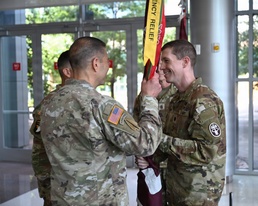
Lt. Col. John Burns relinquished command of the Fort Hood Soldier Recovery Unit to Lt. Col. Michael Finch during a ceremony on Thursday, June 18, at Carl R. Darnall Army Medical Center. He closed out two years leading a mission focused on helping wounded, ill, and injured Soldiers and their families navigate recovery and transition.
For Burns, the Soldier Recovery Unit's mission extended far beyond paperwork and appointments.
"The mission of the SRU is conceptually simple, but practically messy," Burns said. "Our priority is Soldier Recovery. But functionally, the professional Soldiers and civilian staff of the SRU are first and foremost advocates for recovery."
No Soldier expects to become part of a Soldier Recovery Unit. They arrive facing injuries, illnesses and wounds that can alter every aspect of life. Some struggle to coordinate care across multiple clinics and specialists. Others navigate financial hardship, invisible wounds, or uncertainty about the future.
Burns said the SRU helps bring order to that complexity.
"When a Soldier in recovery walks through our doors, they encounter an entire team," he said, including squad leaders who provide empathetic leadership, nurse case managers who coordinate their care, and social workers who help carry the weight that is not visible.
He added that physicians, therapists, administrators, and support staff work together to guide Soldiers through recovery and transition, whether they return to service or move into civilian life.
Col. Mark Jacques, commander of Carl R. Darnall Army Medical Center, praised Burns for maintaining the high standards that have made the Fort Hood SRU one of the Army's premier recovery formations.
"Under your leadership, through incredible dedication and hard work, your team transitioned the SRU from a unit that methodically separates Soldiers to a unit that effectively reconstitutes the Total Army," Jacques said.
Jacques said Burns' legacy is measured in the hundreds of Soldiers the unit helped return to duty or prepare for successful transitions into veteran status.
"Whether returning them back to the fight or preparing them to become productive citizens in their hometowns, you did it with dignity, respect, and unmatched professionalism," Jacques said.
Burns turned his attention to the Soldiers and staff who carried out the mission every day.
"Thank you to you and your families for trusting us to be your teammates in recovery," Burns told Soldiers in recovery. "Your examples of resilience in the face of true adversity often humble and inspire me."
He also recognized the cadre and staff whose work often happens behind the scenes.
"Our Soldiers in recovery do not carry their burdens alone," Burns said. "Every day, you help them lift that load and carry it a little farther."
As he welcomed Finch to command, Burns expressed confidence in the unit's future.
"Command changes, but the mission does not," he said. "The work continues, and it is the worthiest of work."
Burns said he leaves command grateful for the opportunity to serve alongside Soldiers, families, and teammates whose resilience shaped his perspective and reaffirmed the Army's commitment to caring for its own.
"The Army will continue to ask much of Soldiers and families," Burns said. "And when injury, illness, or wounds become part of that service, the Soldier Recovery Unit will be there to shepherd them through the journey of recovery."
He paused before offering his final words as commander.
"I leave today with a full heart," Burns said. "Soldiers First, Soldiers Always."