JOINT BASE ANDREWS, Md. – Inside the heavy steel walls of the altitude chamber at the 316th Operations Support Squadron Aerospace Physiology unit at Joint Base Andrews, Airmen peer through pressure windows watching your every move. A voice comes on instructing them to start working on a simple worksheet that includes personal questions, simple math problems and a maze.
Their fingertips start to tingle; they become dizzy and struggle to think clearly.
Decompression sickness, also known as barotrauma or “the bends,” is caused by a rapid decrease in pressure. This can occur during high-altitude training or unpressurized air travel. When decompression sickness occurs, the body experiences something similar to a shaken, carbonated drink opening. Nitrogen in the bloodstream separates and forms bubbles, obstructing vital blood flow throughout the body.
Some symptoms that an individual might experience from decompression sickness are dizziness, difficulty thinking, and tingling or numbness in the arms and legs. Immediate, emergency treatment involves maintaining blood pressure and administering high-flow oxygen.
Optimal treatment requires the use of a hyperbaric oxygen chamber filled with 100% oxygen.
The 316th OSS Aerospace Physiology unit, in coordination with Maryland State Police Aviation Command – Washington Section Trooper 2 and the Malcolm Grow Medical Clinics and Surgery Center Emergency Care Center, conducted a decompression sickness exercise June 11, 2026. The exercise provided training to understand the signs and symptoms of hypoxia and decompression sickness.
"For us, the criticality is knowing our checklists; [they are] written in blood and it’s important that we follow them,” said U.S. Air Force Lt. Col. Kimberly Dowd, Aerospace Physiology commander. “Making sure that we have checklist discipline, so we don’t have any blind spots, and if we do, what are they so we can practice them in training and be as prepared as possible for someone’s worst day.”
During the exercise, an Airman simulated symptoms of decompression sickness., Aerospace Physiology Airmen jumped into action, calling the base defense operation center to transfer the Airman to the ECC where they simulated the patient receiving further care.
“We never want to create a patient, but we want to make sure that we are trained at the highest level possible,” said Dowd. She noted that if an Airman’s worst day happens in the flight chamber, they know they will receive the care they need.
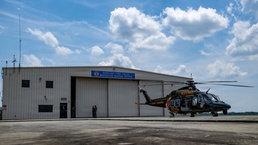
The third prong in the exercise was working with the Maryland State Police Aviation Command – Washington Section Trooper 2, a civilian unit that supports local military partners and responds to medevac requests. Trooper 2 medevaced the simulated patient to the R Adams Cowley Shock Trauma Center at the University of Maryland in Baltimore to complete the exercise.
The traditional transport route with an ambulance from Andrews to Baltimore’s R Adams Cowley Shock Trauma Center takes on average 90 minutes. By adding Trooper 2 into the fold, and getting patients airborne, medical personnel are able to reduce the time to 15 minutes to get patients the critical care they need, reducing the potential for any secondary or tertiary symptoms to set in.
Dowd said the ultimate goal for the exercise was to make sure everyone involved had one common goal. “We are here help you, we want to support you, and it’s really cool to see the partnerships of everyone all in it for the common good of preserving our most valuable asset, our Airmen.”