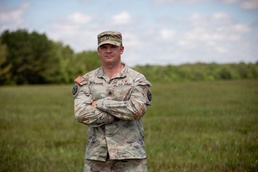
Tennessee Army National Guard Staff Sgt. Anthony McAlister, an 11B Infantryman assigned to 2nd Squadron, 278th Cavalry Regiment, has spent much of his military career supporting reconnaissance operations and developing Soldiers within the regiment. McAlister recently transitioned to a squad leader position and has witnessed firsthand the evolution of reconnaissance capabilities across the force. Drawing from more than 17.5 years of military service and training opportunities around the world, he shared his thoughts on leadership, emerging drone technology, and the 278th's transformation into a Mobile Brigade Combat Team.
Why did you decide to join the National Guard?
“I started off in the Navy in 2009 but after five years, I decided to join the Guard because I wanted to go back to school. In 2014, I switched over to the Tennessee Army National Guard to pursue my education. Along the way, it opened a lot of opportunities for me that I didn't expect."
Do you have family members who have served in the military?
“Yes. I have two brothers who served in the Navy. My father was a combat engineer in the Army and I have several uncles who served across the Marines, Navy, Army and Air Force. Military service has always been a part of my family.”
What are your thoughts on the 278th's transformation into a Mobile Brigade Combat Team?
“I think it's a good thing. It will allow us to be more mobile and accomplish missions that we normally wouldn't have with armor. I think we'll have more resources directed toward Soldiers and equipment and be able to use newer capabilities instead of relying on older systems. Overall, I think it will make us more successful in future missions.”
What are you most excited about regarding the transformation?
“I'm excited about returning to a light infantry-focused formation. We started out that way before transitioning to an armored cavalry team in 2018. I think going back to a lighter, more mobile structure will be beneficial in the long run. The addition of reconnaissance platoons and light infantry companies will help us gain a better foothold on future battlefields.”
What has been your experience training on the new drone systems?
“The X10D unmanned aircraft system is new to me, but I have experience using other drone systems in the past during reconnaissance missions. Unmanned aircraft systems are a tremendous asset, especially when conducting day or night reconnaissance. They allow us to gather information without having to place Soldiers directly on an objective.”
“This X10D unmanned aircraft system offers greater range and endurance than some of the equipment we've used previously. Being able to see beyond the forward line and gather information before committing Soldiers is a significant advantage. Even though this technology is a force multiplier, we will continue to train traditional reconnaissance skills such as observation techniques, sector sketches, range cards and reporting procedures. It's important to maintain the fundamentals in case those systems aren't available.”
What would you like people to know about your National Guard experience?
“The Tennessee Army Guard has been good to me. Like anything, there are ups and downs, but it's what we signed up for. The National Guard has put me in situations that challenged me and helped me develop skills I might not have learned otherwise."
“If you can find something positive in every experience, it helps you grow as a Soldier and a leader. The drone training we're receiving today is another example of that growth. These new systems are going to help us become more capable and effective, both on future battlefields and during training.”
What advice would you give someone considering joining the National Guard?
“If you want opportunities to learn and travel, the Tennessee Army National Guard can provide that. I've had the opportunity to visit about 12 countries and train alongside service members from different nations, including Bulgaria, Denmark, Lithuania, Croatia and Romania. Not everyone gets opportunities like that outside of the military. The opportunities are there if you're willing to pursue them.”
278th Cavalry Regiment Continues Transformation to a Mobile Brigade Combat Team
In May 2025, the Tennessee Army National Guard's 278th Armored Cavalry Regiment was selected as one of three National Guard units to reorganize into a Mobile Brigade Combat Team as part of the U.S. Army's transformation initiative. Since then, the 278th has begun its rapid conversion from an Armored Brigade Combat Team to a Mobile Brigade Combat Team, a lighter, faster and more lethal unit.
A Mobile Brigade Combat Team, which is an enhanced Infantry Brigade Combat Team, is a combat formation with new capabilities that emphasize dispersed, fast-moving operations and the integration of emerging technologies and systems such as the Infantry Squad Vehicle, unmanned aircraft systems, extended-range precision weapons and electronic warfare systems.
As the transformation continues, the 278th is updating its equipment and vehicles, learning new skills and reorganizing to meet the new force structure.
The 278th, which reorganized to its previous armored configuration in 2018, consisted primarily of M1 Abrams tanks and Bradley Fighting Vehicles organized across six squadrons: three armored squadrons, one support squadron, one field artillery squadron and one engineer squadron, comprising more than 3,500 Soldiers.
The new Mobile Brigade Combat Team is organized with three infantry battalions, an additional multipurpose company assigned to each battalion and one multifunctional reconnaissance company assigned to the brigade. The brigade is leaner and more agile, with approximately 1,900 Soldiers.
As a newly designated infantry formation, the 278th has begun receiving and training on new equipment such as unmanned aircraft systems. Soldiers are learning to operate multiple aircraft platforms and becoming experts in UAS operations so they can continue adapting as the technology evolves.
Another significant change is the transition of Soldiers into new military occupational specialties. Guardsmen across the regiment have already begun attending transition courses to train for their new missions and learn how to integrate these new vehicles and systems into future operations.
Soldiers enlisting and commissioning in the Tennessee Army National Guard now have additional opportunities to serve in infantry and other emerging career fields across the state.
Over the next year and a half, Soldiers across the regiment will continue training on their new missions, equipment, and capabilities as the 278th completes its transition to a Mobile Brigade Combat Team, strengthening its ability to serve Tennessee and fight and win the nation's wars.