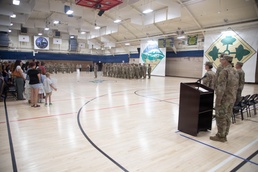
FORT CARSON, Colo. — The 4th Infantry Division Sustainment Brigade known as the Wrangler brigade, have returned home following a 12-month deployment from the Middle East, where they supported large scale military operations, humanitarian missions and multi-domain logistical efforts across 13-countries within U.S. Central Command Area of Responsibility.
“Over the last 12 months, I asked this Brigade to do incredibly hard things. From arriving in theater during the 12-Day War in June 2025, to executing Humanitarian Assistance to Pakistan and Gaza, to sustaining operations across the CENTCOM area of responsibility during major combat operations, this team rose to every challenge,” said U.S. Army Col. Heather M. Reilly, commander. “Time and again, our Soldiers demonstrated resilience, professionalism, and an unwavering commitment to the mission. I could not be prouder to have led such an exceptionally talented team.”
The deployment was originally planned as a routine nine-month rotation. However, due to the military’s large-scale Operation Epic Fury, the brigade deployment was extended 90-days. In March 2026, the 4th Infantry Division Sustainment Brigade assumed additional responsibilities as they bridged the gap between Expeditionary Sustainment Command’s in theater due to troop reductions.
The 4IDSB provided world class sustainment support consistent with the strategic, operational, and tactical priorities of U.S. Army Central (USARCENT) and United States Central Command (USCENTCOM) in conjunction with Joint Logistics Enterprise (JLENT) partners. This enabled the continued re-orientation of the USCENTCOM Area of Responsibility footprint of 13 countries and 37 nodes as the nucleus of resilient and flexible defense ecosystem that leverages residual posture and capabilities for operational reach to meet priorities of National Defense Strategy.
After departing Fort Carson in July 2025, the brigade served a year supporting major military Operation’s Inherent Resolve, Spartan Shield and Epic Fury throughout the CENTCOM AOR. The unit served as a critical sustainment asset in theater; their unwavering commitment and professionalism was evident in the performance of their five support battalions and 38 organizations operating across 17 locations in 13 countries.
“The Soldiers of the 4th Infantry Division Sustainment Brigade and forward battalions demonstrated extraordinary professionalism, adaptability and commitment throughout this deployment,” said U.S. Army Command Sgt. Maj. Michael S. Riggs, brigade CSM. “Their efforts helped strengthen interoperability between U.S. forces, our allies, and partners to strengthen alliances, attract new partners, and deliver a more effective coalition in the region for future operations in CENTCOM.”
Among its accomplishments, the brigade served as the sustainment lead for major international exercises in Egypt, Saudi Arabia and Jordan, while conducting logistics exchanges with military partners from Saudi Arabia, Kazakhstan, Egypt, Pakistan and the United Arab Emirates. Those efforts strengthened regional partnerships, enhanced readiness and directly supported U.S. objectives across the Middle East. The brigade also played a key role in humanitarian assistance operations. Following catastrophic flooding in Pakistan in September 2025, soldiers coordinated the movement of more than 252,000 pounds of relief equipment and supplies within a 96-hour timeframe, working alongside joint and coalition partners to rapidly deliver aid. The operation was conducted under compressed timelines and amid simulated communications disruptions, testing the unit’s ability to execute complex missions under challenging conditions.
In another major effort, 4IDSB supported Civil-Military Coordination Center in support of humanitarian aid operations for Gaza stabilization. The Brigade establishes coordination mechanisms that enabled the safe movement of relief convoys. The unit also prepared personnel and medical support plans for contingency operations tied to the aid mission.
The brigade managed storage, quality assurance, quality control, issuance, maintenance and accountability of munition valued at more than $3.44 billion across the CENTCOM AOR. The unit also managed bulk water production at more than $2.25 million, and bulk fuel valued at more than $29.25 million.
The 4IDSB logistical expertise was further demonstrated following regional conflict known as the 12-Day War. During Operations Blackjack Anvil and Blackjack Cannon, the brigade recovered and accounted for hundreds of pieces of Army equipment and managed the retrograde of sensitive munitions valued at $702 million.
“Thank you for all you have done,” said U.S. Army Lt. Gen. Patrick D. Frank, U.S. central command deputy commander. To provide structure to the transportation assets across the theater”.
Throughout the deployment, the brigade managed approximately 16,000 pieces of equipment valued at roughly $200 million across 11 countries. Leaders said innovative logistics planning generated millions of dollars in transportation and readiness savings while helping maintain a 92% operational readiness rate.
The brigade also oversaw the expansion of many bases in CENTCOM AOR, a project that increased U.S. logistical capabilities in the region. These sites later supported U.S. Navy Central Command, U.S. Marine Central Command, U.S. Air Force Command, and U.S. Army Central Command operations in numerous locations and provided secure storage value for more than $200 million in ammunition.
With heightened regional tension 4IDSB was challenged to execute Operation Hawkeye Strike. The support for the operation displays the epic logistical agility and readiness capability the brigade is known for to fulfill CENTCOM strategic objectives. The brigade synchronized a complex, multi-modal operation to project lethal combat power across the theater. Masterfully coordinating ground and air movements, they maneuvered critical fires assets, armored platforms, and their associated munitions through contested lines of communication. The unit’s ability to plan and execute this large-scale deployment of sensitive equipment within a compressed 96-hour window demonstrated an unprecedented level of expertise and integration with joint partners. Precise execution by the brigade provided the CENTCOM Joint Task Force-Operation Inherent Resolve commander with immediate tactical flexibility and demonstrated a credible and potent deterrent force in the Middle East.
Additionally, in support of OEF the brigade key role in managing critical combat logistics and sustainment resources valued at more than $5 billion, ensuring they were requested, received and distributed in support of large-scale operations in theater conducted by ARCENT, MARCENT, NAVCENT, and AFCENT.
The brigade’s efforts resulted in the strategic emplacement of two forward logistics elements, enabling fires and protection forces through maintenance, transportation, movement control, material handling and ammunition supply point operations. These efforts mitigated critical equipment shortages and personnel gaps across the theater.
The 4th Infantry Division Sustainment Brigade’s support operation section developed and monitored theaterwide munition trackers that improved commanders’ ability to visualize offensive and defensive munitions requirements supporting large-scale operations.
“Pressure is a privilege. During our deployment, our SPO Team was consistently asked to solve complex and unconventional operational challenges in a contested environment,” said U.S. Army Ltc. Stanley A. Crockett, officer in charge of support operations. “Our team was able to streamline sustainment support to the warfighters by rapidly adapting and leveraging the JLENT and multi-national partners. These operational challenges come with extreme consequences, and this pressure enabled our team to increase technical competency and enhance tactical proficiency. It has been an honor to serve with this team.”
While in theater, the surgeon section for 4IDSB implemented improvements to command and medical processes, including the development of Commander's Critical Information Requirements (CCIR) and cultivated a battle drill book to ensure operational continuity. Which culminated in the creation of a new CENTCOM AOR standard for Disease Non-battle Injury tracking (DNBI), correcting a critical information gap and measurably improving force health protection for over 2,000 Soldiers across the entire area of operations. This proactive approach to systemic refinement set a new and enduring standard for operational and medical support, by establishing a benchmark for excellence across the CENTCOM AOR.
“I’m very proud of how our team’s achievement supported our number one priority of people first”, said U.S. Army Ltc. Savannah W. Smith, brigade surgeon. “By improving medical CCIR process, we ensured that command teams and staff at every echelon had the information necessary to coordinate medical care and administration support for our Soldiers.”
The deployment demonstrated the unit’s ability to sustain combat operations, support allies, deliver humanitarian assistance, and rapidly adapt to evolving strategic requirements within one of the world’s most complex operational environments.
-30-