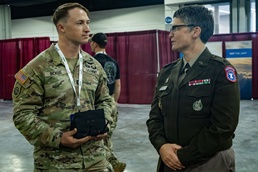
The U.S. Army Drone Team spent June 2-4 at SkillsUSA 2026 connecting with thousands of students,educatorsand industryprofessionals, to highlight how unmannedaircraftsystems are transforming both military operations and civilian industries.
The Army Drone Team interacted withthe next generation of drone operators through hands-on demonstrations and discussions about Army careers in unmanned aviation, providing participants a view of how drone technology is shaping the future of warfare,industryand innovation.
According to SkillsUSA, the organization is one of the nation’s largest workforce development groups, bringingtogether students pursuing careers in skilled trades, technicalfieldsand STEMdisciplines. The eventpresentedan opportunities for students interested in science, technology, engineering and math to engage with young people, specifically those whose interests and talents align with the rapidly growing field of unmanned systems.
“The students here are incredibly motivated and eager to learn,”said Capt. Jacob Bickus, U.S. Army Drone Team, Company A, 1st Battalion, 145th Aviation Regiment, officer incharge. “Many already possess skills in aviation, engineering, robotics and computer science that directly translate into modern drone operations.”
Throughout the event, students visited the Armydroneexhibit to learn about drone technology and discuss their own experiences with robotics programs, engineeringprojectsand aviationrelated activities.Bickusdescribed SkillsUSA as enthusiastic and inspiring, noting that many participants were already familiar with emerging technologies and eager to explore future career opportunities.
“SkillsUSA is developing the technical talent that will drive innovation across America,”Bickussaid. “The technologies students are learning about today are already shaping the future of national defense and industry.”
One of the primary topics discussed during the event was the Army’s newest military occupational specialty, 15X,Tactical Unmanned Aircraft Systems Specialist.
According to Bickus, unlikepreviousspecialties that separated maintenance,operationsand planning responsibilities, the 15X MOS combines those skills into a single role. Soldiers are trained to build,maintain, plan,operateand employ unmannedaircraftsystems, making them versatile assets within military formations.
“The recently established career field is designed to create highly capable Soldiers who canoperateacross the full spectrum of drone missions,” Bickus said.
Bickus said the importance of the new MOS cannot be overstated. Recent conflicts around the world havedemonstratedthe growing significance of unmanned systems in reconnaissance, intelligence gathering, situationalawarenessand both offensive and defensive operations.
“The tactical UAS field is the number one growth area in the military today,”Bickussaid. “Unmanned systems are no longera nichecapability. They have become a fundamental part of how military unitsoperate.”
As the Army invests in emerging technologies,Armyleaders believe organizations such as SkillsUSA help develop the talent needed to support future missions. The technical aptitude,adaptabilityand problem-solving abilitiesdemonstratedby participants closely align with the demands of modern military operations.
“SkillsUSA participants embody the qualities we value most in our Army: discipline, technical competence, adaptability and a commitment to excellence,” said Brig. Gen. Sara Dudley, U.S. Army Recruiting Division commanding general. “Those attributes are essential as we continue integrating advanced technologies into our formations.”
By combining advanced technology, leadership development and hands-on experience, Army service provides a pathway for young innovators to develop skills that are valuable both in uniform and throughout their professional careers.
As SkillsUSA 2026 concluded, Army representatives expressed optimism about the future workforce and the next generation of technical professionals. Through events like SkillsUSA, the Army continues building relationships with students who may one day help lead advancements in unmanned aviation, nationaldefenseand emerging technologies.
“We need talent that thrives in high-stakes, technical arenas. SkillsUSA gives us direct access to students who aren’t just memorizing textbooks; they are actively building, breaking and fixing complex systems,” Dudley said. “If a student can engineer a robotic solution under the bright lights of a competition floor, I want them running our unmanned aircraft in the field.”