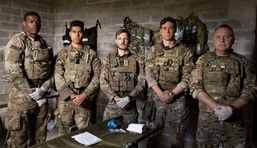
Benowo Piskie, POLAND — For two days, U.S. Army combat medics of the 1st Battalion, 8th Cavalry Regiment (1-8th CAV), 1st Cavalry Division, trained with a team of medics from the British Army’s Light Dragoons.
Medics from both nations who are forward-deployed to Bemowo Piskie Training Area, Poland, have been providing medical treatment during the British Army’s Exercise Guard Streetfighter, which focuses on urban environment capabilities of the Forward Land Forces (FLF) Squadron in Poland, June 16-17, 2026.
The British soldiers had just received their safety brief and were putting on their gear to conduct rehearsals clearing buildings, or what the Army calls close-quarter battle (CQB).
Three U.S. Army combat medics descended down the stairs of a grey brick building wedged between multiple other grey brick buildings of varying heights. In the basement, they would find a room to the right, where a role 1 aid station was set for medics to treat patients on the second day of CQB.
A role 1 aid station provides treatment for immediate and life-threatening injuries prior to hospitalization to save lives.
Greeting the three U.S. combat medics was a captain and lead physician of the British medical team. Alongside him were his medical sergeant and a corporal, his combat medical technician.
After greeting one another, the British medics showed various pieces of equipment, and the British captain went over the algorithms they use when treating a casualty.
Algorithms are used to treat patients in a step-by-step method to consistently save lives.
For example, U.S. Army combat medics use the acronym M.A.R.C.H. M - massive bleeding, A - airway, R - respiration, C - circulation, H - hypothermia or head injury.
The British medics, “follow another algorithm called COMA, in addition to our MARCH algorithm," said Sgt. Ali Hasan, noncommissioned combat medic, assigned to the Medical Platoon, Headquarters and Headquarters Company (HHC), 1-8th CAV. “Which stands for clothing, oxygen, monitoring, and access. They start with cutting the clothes, giving oxygen, getting vitals, and getting intravenous access immediately and then go into their MARCH algorithm.”
Pfc. Royal Pierson, combat medic specialist, assigned to the Medical Platoon, HHC, 1-8th CAV, mentioned that it was helpful to learn about their equipment and procedures prior to the hands-on experience that occurred on day two.
“We have the same goal, but different ways of getting to the outcome,” said Pierson.
Pierson and Hasan treated roughly 10 patients at the aid station alongside their British allied medics on the second day of training.
Patients came in for treatment of traumatic brain injury, leg amputation, sucking chest wound, blunt force trauma, gunshot wounds, and a wound due to an unmanned aircraft system throughout the day.
The aid station ran smoothly, with all soldiers having different roles.
The British sergeant oversaw patient intake. Then the patients were assessed at the triage room, where they were categorized, before being placed onto cots in the treatment room.
Of the training, Hasan said, “it broadened my horizons on what we can do for these patients.”
The British Army physician was able to learn more about Traumatic Casualty Combat Care, which are new guidelines they are transitioning to.
“It was nice to be able to pick up from them what they’ve learned as part of that process and adapt that to our own practices,” said the British Army physician, general duties medical officer of the Fringe Information Network and Electronic Reconnaissance Troop, Bravo Squadron of the Light Dragoons, FLF NATO Battle Group-Poland.
Besides the algorithms being slightly different, the British Army tends to work in smaller teams than U.S. Army medics do.
The British Army physician said, “It was good to see them build their skills as independent practitioners and work not only on their own but as a part of a smaller team doing more per person.”
The physician believes they learned a little from his team’s work and human-factor skills.
Hasan said, “It required a lot of flexibility and tighter communications to ensure everything continued smoothly.”
They had only been working with a team of five at the aid station. Hasan is used to working with a team of 20 for mass casualty training and has participated in this type of training in the past at the National Training Center in Fort Irwin, California.
Pierson said this training is unique because we are training with our allies, which is the reality we will face in any large-scale conflict.
“Being able to train with people that you don’t usually train with and learn new methods just strengthens the adaptability throughout forces,” said Pierson.
U.S. forces in Europe conduct routine training in Poland to enhance interoperability with NATO allies and maintain readiness along the alliance’s eastern flank.