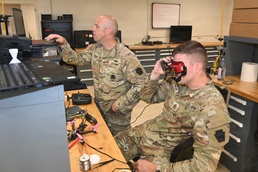
FORT INDIANTOWN GAP, Pa. – The Unmanned Aircraft System Training and Innovation Facility here has been a beehive of activity over the last few months.
On Feb. 19, a team of Soldiers from the facility won the innovation competition at the U.S. Army’s inaugural Best Drone Warfighter Competition in Alabama.
Since then, activity at the facility has “exploded,” said Chief Warrant Officer 2 Nathan Shea, the facility’s officer in charge.
“We’re going through a massive amount of changes,” said Shea, who is assigned to Mike Co., 56th Mobile Brigade Combat Team. “This facility has become a massive hub for training, and our lab space has never been busier.”
Since the Best Drone Warfighter Competition, the UAS Training and Innovation Facility has been chosen to be a training site for the 15X military occupational specialty transition course as well as the primary training site for drones selected in the Department of War’s Drone Gauntlet competition.
As a result of these additional programs, construction is underway on several upgrades to the facility, and the number of full-time employees has increased from six to 16.
“We’ve had a lot of new people come in, a lot of building changes and a lot of equipment changes,” said Sgt. 1st Class Brent Wehr, course manager for the 15X MOS transition course. “There’s been a lot of big changes here.”
A ‘heavy lift’
The UAS facility was established in 2007. Initially, it was home to 28th Infantry Division units that used the RQ-7 Shadow, a fixed-wing UAS with a 20-foot wingspan that was designed for surveillance, reconnaissance and target acquisition.
The Army stopped using Shadows in January 2024, and Soldiers at the facility then began experimenting with small, first-person view, or FPV, drones as they awaited a new mission.
New missions arrived this year in the form of the 15X MOS-T course and the Drone Gauntlet training program.
Pennsylvania was selected to be one of two states, along with Mississippi, to host the 15X MOS-T course for the reserve component. The course is part of the effort to merge two MOSs, 15W (Shadow UAS operator) and 15E (UAS maintainer), Shea said.
“The idea moving forward is an operator and a maintainer will be the same thing, and that’s where we get the 15X,” Shea said.
The first class is expected to begin in October, and Shea expects six classes per year to be conducted at the UASTIF.
The Drone Gauntlet competition, meanwhile, is part of the DoW’s “Drone Dominance” guidance that was issued in 2025. Through the program, the UASTIF will receive eight drones that are selected during the Drone Gauntlet, and Soldiers at the facility will receive training on the drones from their manufactures.
The Soldiers will then train Soldiers from active and reserve component Army units that are selected to receive the drones.
Shea said the UASTIF was selected for this program because of its close relationship with Tobyhanna Army Depot in northeast Pennsylvania and Picatinny Arsenal in New Jersey as well as the work the facility was already doing in the drone space.
“We get the new equipment training from the vendor, and then our job is to train all of active duty as well as some National Guard that have been selected for it,” Shea said. “It’s quite the heavy lift as we go through this.”
Upgrades on the horizon
With the new programs, significant changes are coming to the facility.
A maintenance area that had previously been converted to an innovation lab will be expanded into an innovation classroom. The lab currently has several soldering stations and three 3D printers, with two more printers on the way.
“It’s a space where we can instruct in soldering skills, printing skills, everything like that,” Shea said. “It’s designed to be lab space for Soldiers to receive instruction and give our own people the space to work, tear apart systems, repair systems and everything else along those lines.”
The 3D printers are used for prototyping parts for drones or printing repair parts that may have broken on an existing drone.
Elsewhere in the facility, a high-tech classroom, a simulator room and a locker room are being added as well as office space for the facility’s full-time personnel.
In addition to changes inside the UASTIF, several upgrades are underway outside.
The facility has had an indoor drone obstacle course for about a year and recently built an outdoor course. They are both made primarily from construction material, such as lumber and PVC pipe.
The indoor course is where Soldiers first start learning to fly drones, and the outdoor obstacle course was designed to mimic flying through windows and doors in an urban setting, Shea said.
In the coming weeks, a mock urban village made from shipping containers will be moved to the facility’s grounds from elsewhere at Fort Indiantown Gap to create a UAS-specific urban operations site.
Eventually, Shea said, the facility will have a drone racecourse and host competitions.
An exciting time
Wehr, who has worked at the UASTIF for six years and has been involved in UAS operations for his entire 12-year military career, said it’s an exciting time to be at the facility.
“Shadow was fun back in the day,” said Wehr, who is assigned to Mike Co., 56th MBCT. “It was a more standard schedule, but with all these changes it’s definitely more exciting and more hands-on than it used to be.”
Today’s UAS operators have to know more than just how to fly one; they need to be able to fix them as well, Wehr said. The UASTIF will help Soldiers learn to do both.
“I think it’s a great facility,” Wehr said. “It’s a perfect place to learn how to fly and how to fix drones.”
The UASTIF was already a great facility, Shea said, and with all of the changes that are coming, it’s going to be even more technologically advanced. He noted that six months ago the facility didn’t have any 3D printers or soldering stations, and its classroom space was limited.
“We are building this facility out so that everybody is going to get a better level of education,” Shea said. “We truly are trying to embrace building smarter Soldiers for the future Army. In addition, we’re giving them the tools and training them how to use those tools. The more tools we can put in their back pocket as they move forward, the more ready they’re going to be for future fights.”