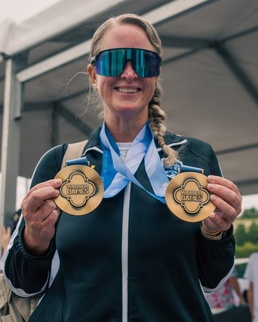
SAN ANTONIO, Texas – June 17, 2026 – Maj. Mandy Feindt came to the 2026 Warrior Games with more than a goal to compete. She came with more than 20 years of Army service, a lifelong athletic background and a recovery journey that has changed how she defines victory.
Feindt, who has already earned several medals during this year’s Games, said those medals represent more than performance. They mark meaningful moments of movement, purpose and possibility after years of uncertainty. “Representing Team Army is incredibly meaningful because the Army has been my home for more than 20 years,” Feindt said. “This year feels especially special because I’m preparing to retire after a career that included deployments, leadership opportunities, and challenges I never could’ve imagined.”
One of those challenges came in 2021, when the Red Hill Water Contamination Crisis affected Feindt’s family and changed her health. The experience forced her to confront what life might look like moving forward.
“When the Red Hill Water Contamination Crisis impacted my family in 2021, I lost a lot of things, including my health,” Feindt said. “There were moments when I wasn’t sure what my future would look like physically, mentally, or professionally. Standing here today as a member of Team Army is proof that difficult circumstances don’t get to write the final chapter of your story.”
For Feindt, Team Army’s mission to turn recovery into victory is personal.
“For me, it means taking back what was taken from me,” Feindt said. “I may never be the exact same person I was before Red Hill, but adaptive sports helped me realize that recovery isn’t about returning to who you were. It’s about discovering who you can become.”
Feindt is no stranger to competition. She began competing at a young age and eventually earned a college track scholarship. Athletics had long been part of how she challenged herself and moved through the world.
“I spent most of my life pushing my body to its limits,” Feindt said. “When my health declined, I thought that chapter was over.”
Adaptive sports through the Army Recovery Care Program and SRU, helped reopen that chapter in a different way. They gave Feindt a path back to competition without requiring her to measure herself against who she used to be. “Adaptive sports gave me a way to a new version of myself,” Feindt said. “That’s victory.”
At the Warrior Games, medals, times and scores help tell the story of competition. For Feindt, the larger victory is found in what recovery has restored to her daily life.
“Victory is being able to do the things I love again,” Feindt said. “It’s getting on my recumbent bike and feeling freedom instead of limitations. It’s spending time with my children and showing them that setbacks don’t define us. It’s proving to myself that I’m stronger than the circumstances I’ve faced.”
Each adaptive sport has given Feindt a different way to move through recovery. Recumbent cycling helped restore her confidence in movement, air rifle gave her space to focus and reset and shot put and discus became productive outlets for frustration.
“Adaptive sports have been one of the most important tools in my recovery,” Feindt said. “It allowed me to reconnect with a sport I loved in an adaptive way and gave me confidence that my body could still do hard things.” “Air rifle became unexpectedly therapeutic,” Feindt said. “It requires focus, patience, and control. For that moment, everything else fades away.”
Feindt said shot put and discus helped her channel anger into action instead of carrying it with her. Together, those sports have helped her heal in ways that reach beyond physical recovery.
“Adaptive sports didn’t just help me heal physically,” Feindt said. “They helped me heal emotionally.”
As Feindt competes, she hopes people see more than a competitor earning medals. She hopes they see someone who kept moving after life changed.
“I want others to understand that Warrior Games competitors are not defined by what happened to them,” Feindt said. “Behind every competitor is a story of resilience, perseverance, and recovery. When people watch me compete, I hope they see someone who refused to quit.”
Her message is also for anyone facing an injury, illness, PTSD or another life-changing setback.
“I also hope they see that adaptive sports change lives,” Feindt said. “They provide purpose, community, healing, and hope. I want them to know there’s still a path forward.”
For Feindt, the 2026 Warrior Games mark competition, transition and recovery in motion. As she prepares for retirement, her performance with Team Army reflects a Soldier and competitor building from what she has endured.
“The goal isn’t to become who you were before,” Feindt said. “The goal is to become the strongest version of who you are now.”