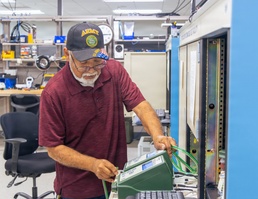
REDSTONE ARSENAL, Ala.— Army logistical efficiency in the Pacific theater received a major boost recently as the U.S. Army Test, Measurement, and Diagnostic Equipment Activity (USATA) officially established localized calibration and repair support for the M41 Protective Assessment Test System, or PATS, at Camp Carroll, South Korea.
The M41 PATS is a vital tool utilized by chemical, biological, radiological and nuclear specialists to ensure the integrity and life-saving seal of Soldiers' protective masks. The system relies on precise aerosol particle counting and airflow measurements to verify mask seals. Previously, systems requiring calibration or repair in the Pacific theater had to be evacuated to the Army Primary Standards Laboratory at Redstone Arsenal.
Spearheaded by the primary laboratory in collaboration with USATA Production, the Theater Sustainment Command-Camp Carroll laboratory and USATA’s Enterprise Support Directorate, this initiative drastically reduces maintenance turnaround times and eliminates the high transportation costs previously required to ship equipment back to the continental U.S.
"Establishing this Portacount automated test facility in the Pacific gives Soldiers a faster turnaround on calibration of CBRN test equipment and drastically reduces overseas shipping costs," said Miles Owen, one of two lead engineers on the project.
"In the event of contested logistics where hardware cannot be evacuated from the region, having this in-theater capability allows for the continued support of gas mask fit testers for six to 12 months without relying on stateside support," Owen said.
This strategic expansion directly supports broader contingency planning for the Pacific region. The effort mirrors a highly successful logistics footprint established in 2004 at TSC-Kaiserslautern, Germany, which continues to support the European theater and Southwest Asia. While the Redstone Arsenal laboratory will maintain support for stateside units, the Camp Carroll facility will serve as the primary maintenance hub for the Pacific, possessing the capability to also support Air Force M41 PATS in the region.
Transferring this highly precise metrology capability overseas presented significant logistical and technical challenges. The testing facility weighs approximately 700 pounds and requires a custom-built infrastructure, including specialized air compressors, air dryers and a newly designed ventilation setup to exhaust fumes. Additionally, the equipment incorporates highly sensitive aerosol diluters, pressure gauges and optical power meters for laser alignment.
Technical challenges also include having expertise consistently in overseas USATA labs. Since Department of the Army Civilians rotate out every few years, it is vital to ensure proper training is given to any new technicians supporting the mission.
“Shipping this equipment overseas had its own challenges once we arrived because the facility contains sensitive test equipment,” Owen said. “Two mission-critical items broke during this trip, one in transit and the other failed near the end of the install. One of the local national experts, Shin, has been at the lab for more than 20 years and located similar spare parts to help fix the system."
Morgan Grisham conducted six days of multidisciplinary training on M41 PATS repair, including aerosols, optics, electronics and gas flow.
"He’s one of the few people in USATA who have the knowledge and skillset to do this," Owen said.
Since the 2004 mission expansion to Europe, diagnostic technology has seen significant modernization. The newly installed particle counters are highly automated, utilize less alcohol to prevent spills, feature an increased measurement range and operate on a 2022 software upgrade that greatly enhances troubleshooting capabilities.
By forward-positioning this automated test facility, USATA continues to optimize Army readiness, reduce transit vulnerabilities and ensure that frontline forces in the Pacific remain fully equipped and prepared for any contingency.