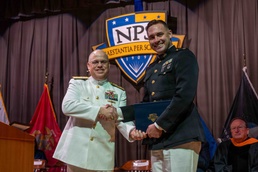
When U.S. Marine Corps Maj. Nickolas Mohr graduated from the Naval Postgraduate School (NPS) in September 2025, he left with more than a master’s degree in computer science — he carried with him a new way of thinking about complex problems.
Less than two months later, that advanced skillset would be put to the test at his new assignment with the 2nd Marine Logistics Group (2nd MLG), where he is now applying his NPS education in artificial intelligence (AI) to help reshape how the unit understands readiness, capacity and operational limits.
Specifically, Mohr is developing the Logistics Capacity Estimator (LCE), an enhanced visualization analytical tool that incorporates streams of real-time unit data to provide a clear site picture to commanders at the battalion, regiment and group level so they can understand if and why they’re able to organically support a particular operation, e.g. a training event or a deployment.
More than just reducing the need for briefings and PowerPoint presentations, Mohr’s leadership at 2nd MLG says the decision space the LCE opens up is substantial.
"The ability to leverage data and artificial intelligence to gain warfighting advantage is an operational imperative,” said U.S. Marine Corps Col. Daniel Coleman, chief of staff, 2nd MLG. “Maj. Mohr tangibly implements what he learned from NPS every day within our Command Data Analytics and Artificial Intelligence Office, reforming the way we operate and improving operational outcomes.”
Mohr’s journey from student to practitioner illustrates the return on investment the Marine Corps gains from sending officers to NPS. By combining academic theory with real-world application, he has translated his education into tools and processes that directly support operational decision-making at the unit level.
At NPS, Mohr’s thesis — titled “Red Team Log Analysis: Tools for Enhancing Cyber Security Operations and Analysis” — focused on cybersecurity and machine learning, specifically analyzing cyberattack logs to determine whether simulated attacks were successful.
“Maj. Mohr’s thesis work began with a very specific focus on analyzing red team activity logs with the goal of using the analyses to enhance cyber defense and operations in the fleet,” explained Alan Shaffer, computer science professor and Mohr’s thesis advisor.
“However, in the absence of sufficient real-world data sets, through his own initiative he expanded his work into experimentation involving the use of large language models to generate realistic log data for machine learning model training,” Shaffer continued. “His thesis work became much more expansive than was originally intended and equipped him with invaluable experience to tackle evolving real-world problems faced by fleet operational forces like 2nd MLG.”
The project began with a daunting dataset: hundreds of logs, each containing thousands of lines of commands and activity. Manually analyzing them was impractical, prompting Mohr and his team to explore automation.
“We discussed building a program that could analyze these logs and determine, with some level of accuracy, whether an attack was successful,” Mohr explained. “That became a foundational step before moving into machine learning.”
As the project evolved, Mohr and his advisors encountered a common challenge in cybersecurity research: limited access to real-world data. Sensitive attack logs are rarely shared, even within government organizations, due to the need to protect tactics, techniques and procedures.
To overcome this, the team generated their own data. Using the MITRE ATT&CK framework, they simulated cyberattack behaviors and created synthetic logs through both Python programs and large language models. These logs were then labeled and used to train machine learning algorithms through supervised learning techniques.
“We trained the model on 75 percent of the data and then tested it on the remaining 25 percent to evaluate performance,” Mohr said. “By comparing different data sets – real logs, synthetic logs and combinations of both – we could measure accuracy and refine the model.”
Beyond the technical achievement, Mohr said the experience fundamentally changed how he approaches problems.
“The thesis emphasized what you can do with machine learning and historical data,” he said. “But just as important was learning how to frame problems in a way that makes them solvable.”
That ability to define and structure complex challenges would prove critical upon his arrival at 2nd MLG in November 2025.
Shortly after checking in, Mohr’s guidance from the commanding general was clear — talk to units across the group and identify areas where he could make a meaningful impact. Over the course of several weeks, he met with leaders from multiple regiments and battalions, gathering insights into operational inefficiencies and systemic challenges.
From those conversations, a central question emerged: how much can the logistics group realistically handle before reaching a breaking point?
“The [commander] wanted to understand the stress on the MLG – what is the maximum capacity, and when do we reach a point where we can’t support additional requirements,” Mohr explained.
To answer that, Mohr began developing LCE.
Leveraging a Palantir software platform known as the Maven Smart System, Mohr and his team are building a visualization tool that integrates real-time data from authoritative Marine Corps and Navy systems. The tool allows planners to define an “event” — such as a deployment or training exercise — based on required personnel and equipment, then overlay that requirement onto the current capabilities of a unit.
“If you define an event as needing 300 Marines with a certain mix of Military Occupation Specialties (MOS) and ranks, plus specific equipment like vehicles and radios, you can overlay that onto a battalion’s current strength,” Mohr explained. “From there, you can immediately see gaps: what you’re short on and where you need support.”
This approach replaces a largely manual process that often relies on outdated data and subjective judgment. Traditionally, planners would export spreadsheets from multiple systems and attempt to piece together a readiness picture. Mohr’s system instead provides a dynamic, continuously updated view.
“We’re trying to push real-time data into a format that gives commanders a clear picture,” he said. “Can they support this mission right now? If not, why not?”
The implications extend beyond equipment and personnel counts. One of the most significant challenges Mohr aims to address is the human dimension of readiness — factors that are difficult to quantify but critical to mission success.
“For example, a Marine might look available on paper, but what the data doesn’t show is that they’ve just completed back-to-back deployments,” Mohr said. “That level of stress isn’t always captured, but it absolutely affects readiness.”
By incorporating historical personnel data and eventually applying predictive analytics, Mohr hopes to forecast trends in manpower and operational tempo. This would allow leaders to anticipate shortfalls and make more informed decisions about deployments and training schedules.
“In the future, we want to analyze five years of historical data — who's coming in, who’s leaving — and use that to predict where gaps will occur,” he said. “That’s where the machine learning piece from my thesis really starts to align with what we’re doing here.”
The project represents a clear example of bridging the gap between operations and technology, an outcome Mohr directly attributes to his time at NPS.
“A lot of planning today relies on talking to someone who did it before and trying to replicate that experience,” he said. “What we’re doing is taking data and turning it into something actionable, something that can inform decisions at every level.”
For Mohr, the transition from classroom to command has reinforced the value of stepping outside one’s comfort zone, a lesson he said was emphasized throughout his NPS experience.
“You can choose to coast after graduation, or you can take on hard problems,” he said. “If you push yourself, that’s where the real impact happens.”
Now, as his work begins to take shape at 2nd MLG, Mohr sees the tangible effects of that choice.
“It’s exciting to go to work knowing that what we’re building could improve someone’s quality of life — maybe by preventing over-deployment or ensuring a unit is properly resourced,” he said. “You may never meet the people it affects, but you know it matters.”
Mohr’s story underscores the broader mission of NPS: to equip military leaders with the tools and mindset needed to tackle emerging challenges. By applying advanced education to operational problems, officers like Mohr are not only enhancing their own capabilities but also strengthening the effectiveness of the force as a whole.
“Maj. Mohr's excellent work at NPS directly supports the institution's mission of enhancing national security by increasing the effectiveness of U.S. armed forces,” said Shaffer.
“Reaching beyond the classroom, NPS provides students like Maj. Mohr with the tools to parlay their academic research into solving actual operational problems,” he continued. “While his NPS master’s education taught him computer science, his overall experience at NPS taught him how to solve emergent problems that our armed forces must deal with and solve for our national security.”
NPS, located in Monterey, California, provides warfighting-focused graduate education, including classified studies and interdisciplinary research, to advance the operational effectiveness, technological leadership, and warfighting advantage of the naval service. Established in 1909, NPS offers master’s, doctoral, and distance learning certificate programs to Department of War military and civilian students, along with international partners, to develop warfighters and leaders who can think critically, solve complex operational problems, and deliver mission-ready solutions through advanced education and research.