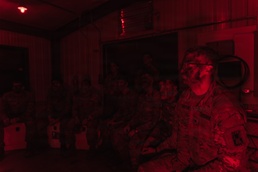
Camp Shelby, Miss. — U.S. Reserve Soldiers assigned to the 416th Theater Engineer Command dismount from their High Mobility Multipurpose Wheeled Vehicle, steam coming off their gun barrels in the cool night air. The energy among the team is ecstatic, they have just become the first section in the U.S. Army Reserve to be master gunnery qualified in nearly ten years.
“I’ve run close to 30 ranges in the last six years,” said Sgt. 1st Class Daryll Slimmer, the 84th Training Command senior gunner and Operation Sentinel Justice gunnery noncommissioned officer in charge “and this is a one-of-a-kind type event…just because these are Reserve Sustainers Soldiers doesn’t mean that they have to do a sustainment style Gunnery.”
The next iteration of Soldiers parked their trucks next to the ammunition point and started loading the weapon systems mounted on top of their Light Medium Tactical Vehicle.
The teams are small, made up of three to four Soldiers depending on their assigned vehicle, but they play a large part in Army Reserve readiness.
“The Army focuses on so much,” continued Sgt. 1st Class Slimmer, “but this provides a drive for Soldiers, a clear path through training evolutions, and makes them confident and comfortable behind their weapon system.”
This event was made up of 14 teams, which is a fraction of the nearly 12,000-Soldier exercise that is Operation Sentinel Justice, but they are selected to be the Army Reserve’s future training force for gunnery events like this one.
“The Army is downsizing the 84th Training Command Senior Gunner program,” said Lt. Col. Jordan B. Scanlan, Operation Sentinel Justice gunnery officer in charge, “but as we see in conflicts like the one in Ukraine, convoy protection platforms are more important than ever.”
As the Army Reserve moves to reorganize units under the regional readiness division structure, the sections qualifying at Operation Sentinel Justice have one more task: take the lessons learned here from the master gunner training teams, bring those lessons home, and train their teams.
“The idea is simple,” continued Lt. Col. Scanlan, “these guys will never go downrange together in this current group, but if they are able to qualify here, become the subject matter experts in their readiness divisions, they can make sure the lessons and experience from the current program isn’t lost.”
There is risk to this plan, with Lt. Col. Scanlan’s method only a proposed course of action; there is a chance that there will be knowledge lost as they downsize the current program.
“I spent a year in Iraq from 2004 to 2005 as an 88M,” Lt. Col. Scanlan said as he reflected on his experience as an enlisted vehicle operator, “our convoys got hit, a lot…not everyone made it back.”
Lt. Col. Scanlan reflected that he and his team are going to do their best to train quality gunnery teams before the program officially downsizes later this year.
“These sustainment Soldiers bring the food, water, and ammo to the guys fighting on the front line,” Lt. Col. Scanlan said, reflecting on the Operation Sentinel Justice gunnery, “and training like this helps to make sure they come home.”