By Leslie Fowler, Integrated Training Area Management Program, Directorate of Plans, Training, Mobilization and Security
The 24 Fire, which started in March 2026, impacted over 7,000 acres of Fort Carson’s training land. Although wildfires are a natural and important part of Colorado’s fire-adapted ecosystems, some fires can create hazardous conditions from increased erosion, runoff and flooding.
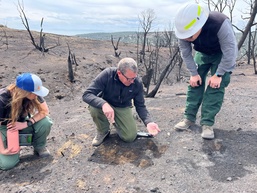
Immediately following the containment of the 24 Fire, Fort Carson staff began planning for land rehabilitation and recovery of the burned area. Fort Carson staff from the Directorate of Emergency Services; Directorate of Plans, Training, Mobilization and Security; and Directorate of Public Works partnered with a Burned Area Emergency Response (BAER) team to conduct a post-fire assessment.
The BAER Program is a federal initiative designed to rapidly assess and address emergent conditions after wildfires on federal lands. BAER teams are made up of interdisciplinary professionals specializing in fields such as hydrology, soil science, engineering, geology, etc. The four visiting BAER personnel, dispatched to the fire to provide inter-agency support, were from local United States Forest Service and United States Geological Survey offices. Assessment objectives were to identify impacts that the wildfire may have on safety, critical values, infrastructure, and natural resources.
The data that the BAER team collected at Fort Carson was used to ground-truth predictive models for soil burn severity, watershed response, and debris flow. Findings largely indicated limited likelihood of increased risk to assets resulting from the 24 Fire. The assessment did identify specific sites that could benefit from additional erosion control measures, as well as high-flow locations to continue monitoring after storm events – often referred to as “Storm Patrol.”
Fort Carson’s Integrated Training Area Management (ITAM) Program reseeded the sites identified for erosion control with a mix of native grass and pollinator-friendly plant species. Subsequent monitoring of the burned area by the ITAM Program also shows limited burn debris accumulation, excellent understory vegetation recovery, and wildlife already returning to the area.
“The Army’s coordination with the BAER Program in response to the 24 Fire encourages valuable collaboration between Fort Carson, state and federal partners,” said Rusty Savoy, Fort Carson ITAM coordinator, DPTMS. “The effort ultimately supports land management decisions promoting long-term sustainable use of Fort Carson’s training lands.”