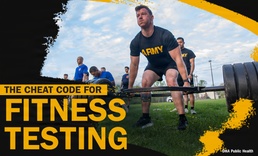
For generations, the image of U.S. Army physical training has been early mornings, endless push-ups, and formation runs. But as the physical demands of modern warfare have evolved, so has the U.S. Army’s approach to building a more lethal and durable force.
From 2019 to 2026, the U.S. Army fitness test evolved from the three-event Army Physical Fitness Test to the six-event Army Combat Fitness Test, and finally to the five-event Army Fitness Test, which became the official test of record on June 1, 2025. Key shifts included adopting age/gender-normed scoring, replacing leg tucks with planks, removing the standing power throw, and increasing focus on combat-specific, functional movements to improve injury prevention and combat readiness. Additionally, the new Combat Field Test, or CFT, is projected to be an additional mandatory fitness test in 2028 for U.S. Army Soldiers serving in specific combat-related roles.
According to a U.S. Army news release, it is designed to be a more accurate assessment of the physical demands required in combat, aiming to improve readiness, enhance lethality, and reinforce the warrior ethos.
The U.S. Army has a history of reflecting on evolving research and changing needs of the force when developing performance- and sports medicine-related assets, said Army Lt. Col. Shay Lopez, injury prevention branch chief for Defense Health Agency-Public Health in Aberdeen, Maryland.
“This began during World War I with physical therapists, then known as “reconstruction aides”, and continued in recent decades with the first physical therapist embedded to Army Ranger Battalions in 2000, the Army Special Forces program known as Tactical Human Optimization Rapid Rehabilitation and Reconditioning, or Thor3, and most recently the Army’s Holistic Health and Fitness Program, or H2F,” said Lopez. “H2F is modeled after Special Forces and professional/collegiate athletics and includes staff and subject matter experts capable of intervention and education in five health-related domains: physical, mental, nutrition, sleep, and spiritual. H2F is intended to move away from a one-size-fits-all model toward addressing every Soldier as unique, and different units as having different missions.”
A 2026 https://journals.lww.com/acsm-tj/fulltext/2026/03000/influence_of_sports_medicine_teams_on_physical.11.aspx published in the Translational Journal of the American College of Sports Medicine, titled “Influence of Sports Medicine Teams on Physical Fitness in U.S. Army Soldiers,” adds to the mounting evidence that embedding health and fitness experts directly into units is revolutionizing Soldier performance.
The study examined the impact of the H2F program's sports medicine teams on Army Combat Fitness Test results. The findings demonstrate that giving Soldiers access to experts such as strength and conditioning coaches, physical therapists, and dietitians delivers performance results.
"To evaluate the impact of Holistic Health and Fitness sports medicine teams during ACFT field testing, we compared Soldiers’ ACFT performance after one year for groups with and without access to these teams," said Tyson Grier, a health scientist in the injury prevention branch at DHA-PH, and lead author of the study. "After training for approximately one year, Soldiers with sports medicine teams showed greater physical performance improvements compared to Soldiers without sports medicine teams."
The performance gaps between the two groups were significant. On average, Soldiers with embedded experts added nearly 18 pounds to their deadlift. But the most unexpected leap in performance happened on the track. "Most surprising was that those with sports medicine teams had a two-mile run time improvement of 31 seconds compared to those without sports medicine teams," said Grier.
Grier pointed out that the two groups were running roughly the same weekly mileage. The significant difference in their run times suggests that it wasn't about putting in more miles, but rather that the specialized training programs designed by the sports medicine teams were simply a more effective way to build aerobic endurance. The secret to these gains wasn't just working harder; it was working smarter, incorporating the known research and programming facilitated by embedded subject matter experts in the unit.
"The implementation of physical training programs developed by sports medicine teams resulted in changes in training, such as more time spent in resistance training, and ultimately greater physical performance on the ACFT," said Grier." Over the course of this investigation, Soldiers transitioned from traditional calisthenics and running to a comprehensive program incorporating additional activities such as resistance training, high-intensity interval training, cross-training, interval training, and plyometrics to meet ACFT requirements."
For Soldiers, the H2F model offers a personalized approach that traditional morning physical training simply cannot match. Whether a Soldier is a top-tier athlete looking to max their fitness testing or is struggling with a nagging injury, the embedded teams are there for them.
"Categorizing Soldiers into ability groups enables targeted improvement for all fitness levels, outperforming 'one-size-fits-all' training approaches," said Grier. "The H2F system moves beyond a standardized model, built on the understanding that each Soldier possesses unique requirements and capabilities. Therefore, Soldiers who might be skeptical can meet individually with the sports medicine team members and address any concerns in a safe environment."
This tailored approach doesn't just improve ACFT scores; it has the potential to make Soldiers more resilient in their daily military occupational specialty, or MOS, duties.
"The human body physiologically adapts to fitness training which eventually makes exercise performed at the same level less strenuous," Grier explained. "Therefore, Soldiers with higher fitness levels can perform similar work tasks at a lower level of effort compared to Soldiers with lower fitness levels."
Grier emphasized that capturing injuries at the onset ensures they remain manageable and do not escalate into serious or chronic conditions. He referenced a February 2026 study published in the journal Military Medicine about a U.S. Army Stryker brigade, where embedded physical therapists and athletic trainers evaluated 63% of musculoskeletal injuries within one week of onset, managing 59% of them without requiring time lost from duty.
"Embedded sports medicine teams provide critical oversight by critiquing and modifying physical training in response to environmental conditions and Soldier wellness indicators, such as recovery status and sleep deprivation," said Grier.
He added that because these experts are right there in the unit, they can evaluate minor aches and pains on the spot. This early treatment keeps Soldiers from being sidelined by worsening injuries and protects the readiness of the entire force.
For commanders, the data presents a clear return on investment.
"Based on the findings from this study, Soldiers with a sports medicine team were stronger, faster and more fit compared to Soldiers without a sports medicine team, contributing to a more ready and lethal force," said Grier. However, realizing these gains takes active leadership. Just having a team available isn't enough; leaders must work with their teams to build a culture that embraces them.
"Leadership support is essential," said Michelle Chervak, DHA-PH military injury prevention division chief. "Commanders should routinely encourage Soldiers to take advantage and optimize the use of their sports medicine teams, talk about the services those teams provide and the outcomes they can help achieve, and provide opportunities to take advantage of these benefits. The goal would be to have 100% utilization of the sports medicine teams."
Being embedded, H2F Teams have the capabilities to participate in and observe Soldiers on the job, said Chervak. By working closely with H2F team members, the SMTs can see what troops actually do every day, and they can tailor workouts and health promotion interventions to the unit's real-world missions.
The success of the H2F model is driving widespread change. In a Dec. 8, 2025, announcement, the U.S. Army revealed plans to roll out H2F Performance Teams to every unit across the service. The U.S. Air Force, U.S. https://www.navyfitness.org/human-performance-optimization and U.S. Space Force are also making similar updates to their human performance and wellness programming. As the military continues to modernize how it treats the human weapon system, data-driven evaluations will remain critical.
"Partnerships like this one, between military public health and those executing, monitoring and reporting on programs, are essential to assess if programs are meeting intended goals, what aspects need further work, and what are working well," Chervak concluded.
The Defense Health Agency is a Combat Support Agency, serving as a force multiplier for the joint services by optimizing lethality through warfighter medical readiness.
NOTE: The mention of any non-federal entity and/or its products is for informational purposes only, and is not to be construed or interpreted, in any manner, as federal endorsement of that non-federal entity or its products.