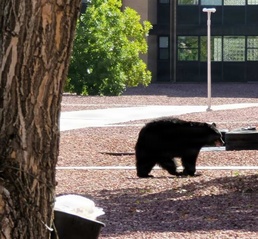
As summer begins and temperatures continue to rise, so do the number of bear sightings around post.
A combination of low snowpack and unseasonably dry weather, seasonal hyperphagia — a biological state where animals experience an insatiable urge to consume up to 20,000 calories per day, overriding their natural weariness of humans, and unsecured garbage have contributed to an uptick in bear sightings across the installation, said Capt. Robert Look Jr., chief of conservation law enforcement for Fort Carson.
This year alone, Fort Carson dispatch has received 23 calls for bear sightings, with the actual number of sightings expected to be much higher. Most sightings have occurred in the housing areas along the west side of Highway 115 as well as controlled access points around the installation.
“Recent mild winters and low snowpack have depleted natural food sources — berries, acorns and plants — at higher mountain elevations,” Look said. “This forces hungry bears down into lower elevations, such as Fort Carson and Colorado Springs, to search for food.”
Look also points to Fort Carson’s proximity to Cheyenne Mountain State Park, a prime black bear habitat, and the surrounding foothills as to why there have been so many bear sightings. Humans exacerbate the issue, he said.
“Unsecured garbage, pet food left outdoors and bird feeders represent highly concentrated, easy-to-access calories for a foraging bear,” said Look. “A bear’s nose is nearly 100 times more sensitive than a human’s, allowing them to detect these items from miles away.”
If you encounter a bear on post, Look encourages community members to stay calm, avoid sudden movements and give the bear plenty of space. Identify yourself by speaking in a low and steady voice. Do not run, instead, use arms and additional clothing to look bigger while backing away slowly. Once at a safe distance or from the security of home or vehicle, call Fort Carson dispatch at 719-284-6370. If exploring one of Colorado’s many trail systems and come across a bear, call Colorado Parks and Wildlife at 719-227-5200.
If the bear continues to approach, stand your ground. Look recommends carrying bear spray for longer outdoor activities, such as hikes or trail runs. If the bear gets too close, aim the spray directly at the bear’s face and spray in a steady stream.
According to Look, direct eye contact or sudden and rapid movements may provoke a bear. Running away is also discouraged, as this may trigger a bear’s chase instinct. Bears can reach speeds as high as 30-35 mph, more than double the speed most humans can achieve.
The following are additional things to avoid if a bear is encountered in the wild:
Look believes that one man’s trash is another bear’s feast. To reduce bear sightings in residential areas, residents are encouraged to secure garbage bins inside garages and sheds while only placing bins outside the morning of their designated trash pickup day.
Additionally, Look suggests taking down bird feeders from April 15 to Nov. 15, as birdseed, suet and hummingbird nectar are extremely high-calorie attractants. For residents breaking out the grill this summer, Look recommends burning off excess grease and thoroughly cleaning grills after every use. Securing grills when they’re not in use is another great way to reduce a potential visit from a hungry black bear.
“Heading into the summer months, it’s on all of us within the Fort Carson community to take these precautions seriously and remain bear aware,” said Col. Erik Oksenvaag, garrison commander of Fort Carson. “Parents, talk to your kids about what to do if they see a bear on post, and when in doubt, let dispatch know if you think you’ve seen one roaming around the installation.”
For more information on bear safety, visit https://cpw.state.co.us/living-bears..