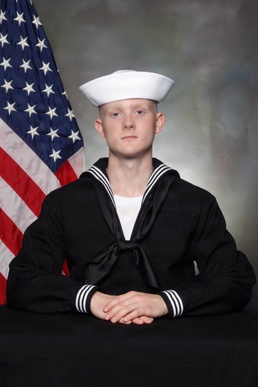
GREAT LAKES (NNS) – Fireman James Codd IV graduated as the top Sailor from Recruit Training Command (RTC) Great Lakes, earning the Military Excellence Award (MEA) June 18, 2026.
Codd, 20, of Mt. Airy, Maryland, said the award was not exactly part of the plan.
"I came to boot camp intending to be a fly on the wall," Codd said. "I didn't want any special jobs or responsibilities. I just wanted to do what I was told, graduate and start my Navy career. Since getting this award, I feel a lot more proud of myself — it means I did my job successfully and helped my fellow recruits get there too."
The Military Excellence Award is presented to the recruit who best demonstrates enthusiasm, devotion to duty, military bearing and teamwork throughout training. As part of the recognition, recipients receive a flag letter of commendation.
When FCA1 Lemond assigned Codd as section leader early in training, the quiet boot camp he had envisioned gave way to something he hadn't anticipated.
"Being made section leader meant I was doing something right, but it also came with some worry," Codd said. "I had never been in a real leadership position before. I had to figure it out."
Service had always been somewhere in the background. Codd is the fourth in a line of James Codds to wear a uniform. His great-grandfather served in the Navy, his grandfather in the Army and National Guard, and his father, James Codd III, in the Marine Corps Reserves. Growing up watching his father, he always assumed the military was somewhere in his future.
The path there took a detour first. Straight out of Linganore High School, where he graduated in the top five percent of his class as a National Honor Society member, he went to work as an electrician's apprentice, handling residential service work from replacing receptacles to performing panel upgrades. The work was steady, but something was always pulling at him.
"I never felt totally satisfied and would always wonder what would have happened if I had joined the military," Codd said. "After about a year, the company went under and I felt like it was a sign to enlist. I wanted something difficult and, because of that, fulfilling."
His search for a rate landed on nuclear, among the most technically demanding paths in the Navy, and one where his electrical background would carry directly into the work ahead.
That same patience with complexity was exactly what boot camp's hardest challenge demanded. Getting 80 to 90 recruits from completely different backgrounds to function as a unit didn't happen on its own.
"The biggest challenge was learning to be patient with myself and the rest of my division," Codd said. "When you put that many people from different walks of life together, you're going to get friction. The first step was accepting that we're all different. The second, putting those differences aside and working together, is what boot camp is really about."
Letters from his parents and siblings arrived consistently throughout training and gave him something to look forward to each week. His RDCs, Chief Petty Officer Chanel Hewitt, Petty Officer 1st Class Joshua Lemond and Petty Officer 2nd Class Kalani Duong, pushed from the front, with the section leader assignment carrying its own quiet message of confidence.
For anyone back home with a fixed image of what boot camp looks like, Codd wants to reframe it.
"Boot camp is not just PT and getting yelled at," he said. "It's mostly about putting recruits in a position where they have to work together. When a division gets corrected as a unit, some people might think that's unfair — but in reality it encouraged everyone to help the ones who were more confused."
Following graduation, Codd will report to Charleston, South Carolina, for Machinist's Mate Nuclear "A" school, where he will study electrical systems, power distribution and the technical foundations of nuclear propulsion.
Training at RTC is approximately nine weeks long, and all enlistees in the U.S. Navy begin their careers at the command. More than 40,000 recruits train annually at the Navy's only boot camp.