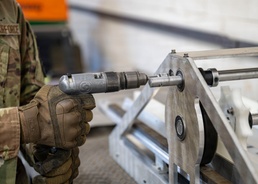
HURLBURT FIELD, Fla. -- The 1st Special Operations Wing introduced a new 30 mm ammunition-linking machine at Hurlburt Field on April 21, 2026, an innovation set to save the Air Force millions by repurposing rounds from retiring A-10 Thunderbolt IIs for use on AC-130J Ghostriders.
The initiative stems from the planned future retirement of the A-10, which will leave millions of 30 mm rounds without an assigned platform. The Air Force plans to transfer several hundred thousand of those rounds a year to Air Force Special Operations Command for use on the gunships.
However, this transfer presented a logistical hurdle: the A-10 employs unlinked ammunition, while the AC-130J requires continuous belts for automatic, high-rate feeding. The new machine bridges this gap by connecting up to 15 rounds in seconds, shifting munitions management directly into the hands of Airmen rather than expensive external vendors.
AFSOC has forged a partnership with the 116th Maintenance Squadron at Robins Air Force Base to accelerate operational efficiency. By integrating the specialized manpower and dedicated logistical infrastructure of the 116th MXS, this strategic initiative enhances our operational footprint while securing approximately $4 million in annual cost savings for the Air Force, directly reinvesting resources into warfighter readiness.
“Vendors wanted roughly $9 million to do 200,000 rounds,” said a munitions functional manager assigned to Air Force Special Operations Command. “It’ll just cost the command around $10,000 in shipping charges to move ammo, but it’s a direct-cost savings.”
The increased availability of ammunition will also support more consistent training among aircrews, increasing operational effectiveness.
“Currently, we’ve restricted the air crews on how much ammo they can shoot,” said the munitions functional manager. “Being able to bring on all these extra millions of rounds from the A-10, we can get back up to a higher standard for our air crews to train at a much lower cost.”
On the ground, the transition is expected to be seamless for maintainers.
“It doesn’t change our process too much,” said a conventional maintenance crew chief assigned to the 1st SOW. “It adds one extra step, but it’s really not much different from what we do on a day-to-day basis.”
AFSOC and its partners are targeting October 2026 for full implementation of the new machine, according to the munitions functional manager.
“It's neat to see something we’re touching could eventually be implemented for future ammo troops,” said the conventional maintenance crew chief. “I feel really privileged to be a part of that, and I think our guys here feel the same way.”
With implementation on the horizon, the effort reflects the 1st SOW’s broader focus on innovation, devised to support the mission now and reflect the ever-changing global landscape.