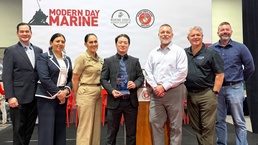
A Defense Health Agency cross-functional team was honored at the Modern Day Marine 2026 Artificial Intelligence Forum Hackathon for building an AI prototype that delivers real‑time blood product and inventory in support of INDOPACOM.
DHA representatives from DHA’s Medical Logistics, Office of the Chief Information Officer, and Chief Data and Analytics Office participated in the hackathon sponsored by the Marine Logistics Command and industry partners, April 27-30, 2026, in Washington, D.C.
“As a combat support agency, bringing innovation in support of the warfighter is critical,” said team member Junayd Park, CDAO, functional lead for application prototyping and integration. “Attending hackathons provides us the opportunity to think outside the box to refine meaningful use cases in support of the combatant commands.”
Park, along with Barinder Dhillon, CDAO, operations research analyst; Jason Miller, MEDLOG, chief, data and information and management branch; Nigel Stone, MEDLOG, biomedical engineer; David Wang, MEDLOG, information technology specialist, communications and knowledge management branch; Michael Mulkey, AI engineer, engineering, systems, and architecture branch, and Navy Cmdr. Janette Arencibia, PEO Medical System/CIO, chief, combat support agency integration, comprised the team.
Teams were evaluated on technical execution, feasibility and operational realism, innovation under pressure, and the ability to demonstrate mission relevance.
During the 17-hour sprint, the team demonstrated DHA’s quick ability to deliver practical tools for the joint force through building the working prototype, according to Dr. Jesus Caban, DHA chief data and analytics officer. “Their work showed the speed, skill, and mission focus we need across the enterprise. By turning a concept into a working prototype under pressure, the team highlighted how DHA, in alignment with the Department of War’s AI strategy, deliver tools that support readiness in contested environments under pressure and limited time.”
Harnessing AI, the team’s prototype offers predictive decision support that blends DHA medical logistics data with operational data to help leaders predict supply chain disruptions before they occur, improve sustainment planning, and support faster, data-driven decisions.
“Medical logistics is not just a support function — it’s a front-line capability to sustain our warfighters,” Arencibia said. “Ensuring our medical supply chains can deliver blood products to the point of need is a critical battlefield capability — and it’s quite literally a matter of life or death.”
According to Park, these high-pressure, hands-on environments strengthen the DHA’s ability to deliver AI-driven solutions at the “speed of relevance” for combatant commands, equipping leaders with the information required for mission success.
“This achievement shows how DHA is becoming a data and AI-first organization in a way that directly supports the mission,” Caban said. “Our goal is to deliver decision advantage for the warfighter, strengthen combat support to the services, and improve the care all of our beneficiaries deserve.”
Hackathons and other hands-on learning opportunities enhance the DHA’s “journey to becoming an AI-first organization, by providing opportunities for staff to innovate, learn, and connect,” highlighted Jennifer Snyder, CDAO, user engagement and data literacy lead.
“By bringing different DHA entities together to solve real-world operational challenges in real-time, these modernization initiatives foster the joint collaboration necessary to deliver modern capabilities to support operational challenges,” added Snyder.
The DHA is prioritizing opportunities for its workforce to modernize and be technologically capable, in support of DHA Director Vice Adm. Darin Via’s lines of effort. Through training, custom resources, and fostering a community of practice, the DHA is advancing data literacy, analytics and the responsible adoption of AI to deliver the decision advantage for our warfighters.
The DOW’s AI Strategy stated “the time is now to accelerate AI integration,” and for the DHA, AI is not a future concept. It is part of the agency’s effort to become an AI-enabled force committed to delivering timely, high-quality care throughout the enterprise.