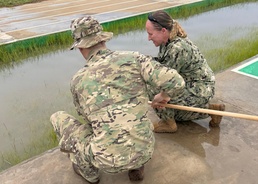
CAMP LEMONNIER, Djibouti - Following the conclusion of Exercise Flintlock 2026 on April 30, Naval Medical Research Unit (NAMRU) EURAFCENT is applying operational and scientific experience gained during the multinational exercise to strengthen force health protection and warfighter readiness at Camp Lemonnier, Djibouti.
A key part of this effort is the work of Cmdr. Rebecca Pavlicek, detachment director in Cairo for NAMRU EURAFCENT, whose role during Flintlock helped reinforce how medical readiness supports mission success in complex and high-risk environments.
During the exercise, she helped strengthen the integration of force health protection into multinational planning and execution, enhancing collaboration and decision-making among participating leaders.
“We took everything learned at Flintlock 2026 about fielding a lab and genomic sequencing in a [simulated] kinetic forward combat environment and have used that knowledge to build on our capabilities to support the warfighters at Camp Lemonnier,” said Pavlicek.
That transition from exercise to forward application underscores a central takeaway from Flintlock: effective operations depend on the ability to anticipate, identify and mitigate health threats before they affect the force.
Integrating research capability into operational decision-making directly supports combat effectiveness through early disease detection, environmental health awareness and preventive medicine in austere environments.
Exercise Flintlock 2026 brought together approximately 1,500 U.S. service members and more than 30 African and international partner nations to enhance interoperability, strengthen counterterrorism capabilities and improve coordination across borders.
Conducted across multiple locations in North and West Africa, the exercise focused on building collective readiness through joint training, operational planning and tactical simulations designed to address shared regional security challenges.
NAMRU EURAFCENT is building on that experience by training staff on the MinION sequencer, a portable device for real-time DNA and RNA sequencing. Naval research laboratories are leveraging these technologies during field testing in support of the warfighter. Pavlicek’s expertise in diagnostics, treatments and field-deployable technologies supports efforts to address emerging infectious risks to deployed forces.
Her experience further reinforces the command’s ability to advance force health protection and translate scientific capability into operational relevance in forward environments.
“When an invisible threat such as emerging pathogens, infectious diseases and environmental health risks approach the region, NAMRU EURAFCENT is ready and willing to jump in the fight,” Pavlicek added. Exercise Flintlock 2026 demonstrates how medical readiness is essential to operational success in any environment and allows the command to integrate medical developments into operational planning and ensure warfighters are prepared to operate in complex and high-risk settings.
NAMRU EURAFCENT, part of Navy Medicine Research & Development, conducts research, surveillance and studies of vaccines, therapeutic agents, diagnostic assays and vector control measures in the EUCOM, AFRICOM and CENTCOM Areas of Responsibility to better prevent and treat infectious diseases in support of Navy, Marine Corps and joint U.S. warfighter health, readiness and lethality.