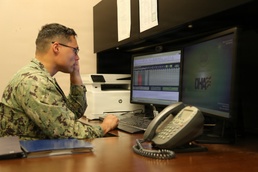
LEMOORE, Calif. (June 10, 2026) –Time is money. In the world of military medicine, that age-old adage is not just a cliché, but a direct formula for readiness, clinical resources and command funding.
In military medicine, there is an often-overlooked administrative responsibility behind patient care, it’s called the Defense Medical Human Resources System-internet, or DMHRSi. To many who work in military medicine, it has long been viewed as just another mandatory chore, a digital black hole where hours are logged, but very little, if any feedback is returned.
At Naval Health Clinic Lemoore (NHC Lemoore), one sailor refused to let administrative compliance remain a mindless task. By introducing transparency to a system long defined by "the unknown," Hospital Corpsman 1st Class Jordan Cooper has transformed how the command tracks its labor since February. NHC Lemoore has made great strides in DMHRSi metrics within the Defense Health Network Pacific Rim.
During a June 10 morning huddle, Capt. Robin Bennett, deputy director of NHC Lemoore, recognized the command for its notable improvement in DMHRSi codes in clinical, administrative and training labor codes that are tied to the network’s strategic initiatives.
At the heart of this success is a customized, user-friendly Excel time-tracking calculator built by Cooper, who serves as the Leading Petty Officer (LPO) for Staff Education and Training.
"Before this tool, the biggest frustration for our sailors was the unknown," Cooper said. "When a sailor inputs their hours directly on the DMHRSi website, there is zero feedback on whether they are on track or falling short. They would submit their timecard having no idea what the metrics were, what percentages they needed to meet, or whether their inputs were supporting the command’s funding picture. That lack of transparency created a lot of frustration for leaders and junior sailors alike."
Recognizing that frustration, Cooper set out to design a solution that felt familiar but worked smarter. He built a digital spreadsheet that replicated the exact layout of the standard DMHRSi timecard, ensuring sailors would not have to relearn a new interface. Then, he layered in the features of an interactive dashboard.
"I wanted to build something that worked smarter instead of harder," Cooper explained. "The spreadsheet uses color-coded indicators, clear notices and instant feedback. Instead of guessing whether their hours meet DMHRSi intent, a sailor can look at the spreadsheet and know immediately where they stand. Green means good, and red means adjust. It removes the guesswork completely from the equation."
Having a tool that mirrored the timecard they already knew, but told them what they needed to know, made a noticeable difference across every department.
Cooper is quick to point out that a tool is only as good as the sailors and leaders who utilize it. The true success of the program, he notes, lies in using the data to foster a deeper understanding of military medicine’s resource management.
"The tool itself is only a part of the solution," Cooper said. "The real difference is made by the leaders who use it and take the time to educate their sailors on why it matters. Funding should not be blindly allocated. There must be accountability, and DMHRSi is that accountability. The metrics lay out a clear roadmap for how our time should be managed, and this tool helps leaders bring that roadmap down to the deckplate level."
For Cooper, leadership extends far beyond logging hours. He challenges command leadership to use the administrative efficiency gained from his calculator to reinvest in their personnel.
"Do not just have your sailors log a nine-to-five schedule and call it done. Use that time to invest in their personal and professional development. Get the department out for command physical training and create opportunities for them to work on their collateral duties. When leaders embrace that mindset, then the hours, metrics and funding will naturally reflect what 'right' looks like, and it decreases the burden of this administrative chore."
This balance of administrative efficiency and operational focus comes at a critical time for the clinic. In addition to daily clinical care, NHC Lemoore sailors have been actively undergoing intensive readiness training with Expeditionary Medical Facility (EMF) Bravo, preparing the command for rapid activation and deployment whenever the nation calls.
To honor his ingenuity, leadership and contribution to the command, Bennett presented Cooper with a command coin.
"The region recognized that the reason we do so well on these metrics is because of the hard work that you all are putting into account for your time," Bennett told the command. "With HM1 Cooper's spreadsheet as a guide, you have made a massive impact. Sometimes we assign these tasks, and you do not realize the direct connection, but it equals the money we receive to pay for the resources we need to do our daily jobs. Thank you very much for putting in the time and doing the work."