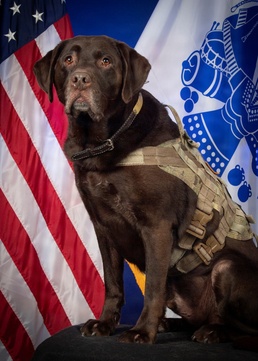
Staff and patients at Walter Reed National Military Medical Center were recently saddened to say goodbye to a deeply loved team member. Truman, the long-standing facility dog for Walter Reed’s Military Advanced Training Center (MATC) passed away in May 2026 after a brave fight against cancer.
A chocolate Labrador Retriever with soulful eyes, Truman joined the MATC team in January 2016. He was an important member of the facility’s team, as he provided comfort and consistency to patients recovering from amputations and traumatic injuries.
“Truman was a big, strong looking dog,” said Harvey Naranjo, the MATC’s Adaptive Sports and Reconditioning program manager and Truman’s handler. “He had very welcoming eyes that told people he was their friend and that everything was going to be okay. He [exuded] peaceful calmness, and he embodied the word service. He looked forward to working and being around people. He was not happy on the days he was not coming to work with me.”
Naranjo feels Truman had an innate understanding of what was needed from him.
“That was one of the things that made him special,” said Naranjo. “He was phenomenal at pinpointing who in the MATC needed him at that moment, for however long they needed him for, whether it was 10 minutes or the whole treatment session. He just knew who he needed to hang out with, who needed his support.”
Truman was brought to the MATC following the passing of Deuce, Naranjo’s first facility dog, who was also a chocolate lab. Facility dogs like Truman and Deuce are specially trained and acquired through accredited organizations that spend years preparing them for the highly sensitive and often stressful work they are required to perform.
“All the dogs that come into the program were previously trained as service dogs,” said Amy O’Connor, program manager for Walter Reed’s facility dog program. “A service dog is trained to work with a disabled individual to help mitigate that person’s disability and increase their ability. Once they’ve career changed to facility dogs, they’re no longer working in that capacity [with a single individual]. So, we get these highly trained dogs whose mission is to increase well-being and decrease stress and in a place like the MATC a lot of these men and women are here for a long time. These dogs become part of their family.”
O’Connor went on to say that every hour a facility dog like Truman works in an environment like the MATC, they can touch the lives of approximately 12 people. Cumulatively that can amount to more than 2,500 contacts each month. For Truman that was the ideal situation, and for 10 years he lived his perfect life.
Michelle Sheedy first came to the MATC in 2023. Formerly a lieutenant commander in the U.S. Public Health Service Commissioned Corps, as well as having served as a boatswain’s mate in the Coast Guard and combat medic in the Army, Sheedy was injured and suffered from Chronic Regional Pain Syndrome (CRPS) for many years. Ultimately the CRPS resulted in the amputation of her right leg. She met Truman during her first orientation visit to the MATC prior to her operation, as she prepared for the major changes her life was about to undergo. At the time, she had no idea of the impact the quiet dog would have on her.
“I had never had any kind of interaction with therapy dogs, and I wasn’t sure about the role that Truman would have in my recovery before I had the amputation,” said Sheedy. “When I returned to the MATC post-surgery, Truman was there. He was the one that was consistent. He was there when I was crying in pain, and when I was crying because I felt alone. Every day I was able to look forward to Truman being there. He met me as soon as I walked in the door.”
Any time Sheedy would be in the MATC, Truman would follow her from exercise to exercise. Most people attributed it to her tendency to have treats for Truman with her when she came, but she knows it was more than that. Truman remained by her side whether she had treats for him or not.
“When I would wheel myself into the MATC in my wheelchair, I would be physically fatigued and my heart would be racing,” said Sheedy. “Once I was there, I could feel my heart start to slow down, just from his presence.”
Truman became such an important part of Sheedy’s recovery she began thinking of him, at least in part, as her own dog.
“Anywhere we went that we saw pet treats or toys or anything that was for a pet, it was for Truman,” said Sheedy. “Anytime people talked about their pets, I would show them pictures of him.”
According to Naranjo, when it came to Truman, Sheedy’s story is a familiar one. He remembers many Walter Reed patients that experienced similar attachment to the gentle facility dog. One that stood out was a former Marine who was battling terminal cancer. During his visits to the MATC, he developed a close bond with Truman. Through his pain and struggles, Truman was always there for him. The Marine’s final wish was for Truman to be with him in his hospital room. Despite being almost unconscious, the Marine knew when Truman came into the room. Naranjo takes comfort knowing Truman meant so much to so many people going through their most difficult life challenges.
“We’re missing Truman now,” said Naranjo. “We’re going to get another facility dog, but there will never be another Truman. There will never be another Deuce. But hopefully the new one will build off the legacy they’ve left behind.”
For more information on the MATC and the services it offers, please visit the center’s website at Walter Reed National Military Medical Center - Military Advanced Training Center (MATC).