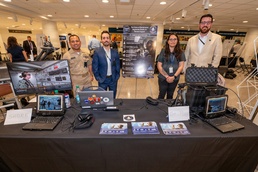
Scientists and engineers from four NAVSEA Warfare Centers Divisions were among those from across the Department of War (DoW) showcasing technological advances during the 2026 DoW Lab Day at the Pentagon.
Sponsored by the Office of the Undersecretary of War (USW) for Research and Engineering (R&E), the one-day pop-up exhibition in the Pentagon apexes on May 6 brought together organizations from all services, including across the Navy Research and Development Establishment (NR&DE). The event provided an opportunity for military members, flag-level leaders, defense industry partners and representatives from the Office of the USW(R&E), including USW(R&E) Emil Michael and Dr. Jagadeesh Pamulapati, principal director for Science and Technology Foundations, to engage directly with scientists and engineers developing future warfighting capabilities.
“The collaborative ingenuity of the NAVSEA Warfare Centers was on full display at the 2026 DoW Lab Day,” said Deeba Chowdhury, Senior Scientific and Technical Manager (SSTM) for Engineering and Technology for Warfare Centers Headquarters, who attended the event. “Showcasing critical technological leaps, our teams from NSWC Crane, Port Hueneme, Dahlgren and Philadelphia proved that when our Warfare Centers collaborate both internally and externally, we accelerate the delivery of vital, next-generation capabilities to the warfighter.”
The first Lab Day was held in 2015 as part of an outreach campaign to tie together science and technology efforts across the department’s R&E enterprise. The latest event featured more than 20 exhibits with technologies demonstrated by representatives from the Navy, Army, Air Force and Space Force.
Participating Divisions provided the following summaries of their presentations:
Lethal Autonomy at Speed: NSWC Crane Division: Andrew (Andy) Myers, ammunition engineering project analyst, Patrick R. Flannagan, Program Executive Office (PEO) Integrated Warfare Systems (IWS) customer advocate, and Max Irwin, chief scientist for weapons system development, represented NSWC Crane Division at Lab Day. Their presentation highlighted the Drone Killer Cartridge (DKC) system and an unmanned system that featured various sensor payloads.
These projects are examples of the rapid development teams within NSWC Crane Division, which work to transition advanced science from the laboratory to practical, urgently needed naval applications.
“DoW’s Lab Day was an excellent opportunity for us to showcase our relevant technologies that have transitioned to the warfighter,” Flannagan said. “NSWC Crane’s functions put us where we are needed most; we are in the field with the warfighter, coming up with the solutions they need now.”
Drone technology continues to evolve based on its potential for various applications, and DKC provides a ready countermeasure against the emerging threat of weaponized small unmanned aerial systems (sUAS). It is a cost-effective, U.S. government-owned solution that enables extended range, shotgun-like effects for enhanced kinetic response to sUAS. Critically, with the bullet separating into smaller pieces, collateral damage is also inherently reduced when compared to standard combat ammunition of the same caliber. This effort reflects NSWC Crane Division’s role in developing relevant, rapidly fieldable capabilities that support military readiness and reduce operational risk for forward-deployed troops.
Augmented Reality Maintenance System (ARMS): The Future of Maintenance: Augmented Reality for Remote Support: NSWC Port Hueneme Division: Capt. Richard Duldulao, NSWC Port Hueneme Division's Chief Engineer, Mike Confessore, lead software engineer with Naval Air Warfare Center Aircraft Division (NAWCAD) Lakehurst, and NSWC Port Hueneme Division engineer Fatima Alba and computer scientist Nick Bernstein, members of NSWC Port Hueneme Division’s Augmented Reality Maintenance System (ARMS) team, represented ARMS and the NR&DE at Lab Day.
The team provided live demonstrations and discussed the system with a joint-service audience throughout the event. Team members also highlighted the capabilities of the cross-systems commands team behind ARMS and established potential avenues for future cross-service collaboration. ARMS was developed by a team led by project manager Ryan Bowersock and Confessore at NAWCAD’s Creative Lab in Lakehurst, New Jersey.
In addition to the ARMS team, NSWC Port Hueneme Division’s Hugo Ontiveros, an action officer for Department of the Navy exhibitions supporting the Deputy Assistant Secretary of the Navy (DASN) for Research, Development Test and Engineering (RDT&E), also attended.
Directed Energy: Next Evolution in Countering Threats: NSWC Dahlgren Division: Representatives from NSWC Dahlgren Division’s Integrated Engagement Systems Department, including Mick Williams, Alan Overby and Chelsea Duncan-Bumpers participated in the event, showcasing directed energy capabilities, and discussed ongoing High Energy Laser (HEL) and High Power Microwave (HPM) efforts. The event provided opportunities to engage directly with senior DoW leadership, including discussions with Pamulapati, regarding HPM and HEL technologies.
Discussions focused on the growing role of directed energy systems in countering modern threats such as unmanned systems and coordinated swarm and raid threats. The event provided an excellent forum to educate policymakers on directed energy capabilities and address questions through direct one-on-one engagement with NSWC Dahlgren Division personnel. Attendees expressed enthusiasm for utilizing directed energy to cost-effectively counter modern threats, particularly in one-on-many engagements.
Magnetic & Acoustic Generation Next Unmanned Superconducting Sweep (MAGNUSS): Autonomous Minesweeping with Advanced Materials: NSWC Philadelphia Division: Engineers Peter Ferrara, Naval Superconducting Technologies Applied Research (N-STAR) team lead, and Theresa Vaites, N-STAR technical project manager, represented NSWC Philadelphia Division at DoW Lab Day, presenting “Autonomous Minesweeping with Advanced Materials.”
Their poster highlighted the Magnetic & Acoustic Generation Next Unmanned Superconducting Sweep (MAGNUSS) system. MAGNUSS focuses on route or area clearance of magnetic and acoustic influence mines by using a compact superconducting electromagnet that fits into the existing payload area on unmanned surface vehicles. It is a non-towed payload with the ability to operate in shallow or cluttered operational areas, and its performance is independent of salinity or bottom type. The effort reflects NSWC Philadelphia Division’s role in developing naval machinery, power and energy technologies that support Navy readiness and reduce operational risk for Sailors.
“The DoW event was a good opportunity to interact with the Naval Research and Development Establishment, highlighting new technologies being worked on by Navy labs for the fleet,” Ferrara said.
The event at the Pentagon provided NSWC Philadelphia Division with a platform to discuss the superconducting and cryogenic technology behind MAGNUSS and other applications for the Navy. In addition, it gave the N-STAR team an opportunity to highlight the command’s technical depth in superconductivity and systems integration. The N-STAR team is just one of the teams within NSWC Philadelphia Division’s Energy Conversion R&D Branch, which works to transition advanced science from the laboratory to practical naval applications.