The Idaho Army National Guard’s 116th Cavalry Brigade Combat Team’s engineer battalion was inactivated last week and several new companies were activated in the proceeding days as the brigade began the transition from an armor brigade to a mobile brigade combat team.
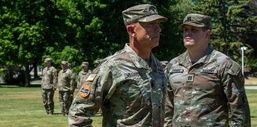
The 116th Brigade Engineer Battalion was inactivated Friday, June 5, in Twin Falls. During the ceremony, the battalion’s and each subordinate companies’ guidons were cased, signifying the end of the battalion’s lineage.
“A unit’s colors are its soul,” said Col. Jason Gracida, 116th CAV (MBCT) commander. “They hold the battle streamers of past conflicts and the sweat of training rotations. When we case these colors today, we are not erasing history, we are securing it. We are preserving the legacy of a battalion that has repeatedly answered the call and executed its mission with absolute precision.”
The inactivation ceremony was the first of many changes for the 116th CAV (MBCT), as the brigade reorganizes as part of the U.S. Army’s Transformation Initiative. The strategic modernization effort is designed to strengthen the military’s capabilities in response to emerging global threats by adapting fighting formations and integrating new technologies to prepare units and Soldiers to fight on the battlefield of the future.
The engineer battalion was established on March 16, 2006, as the 116th Brigade Special Troops Battalion and converted to the 116th Brigade Engineer Battalion on October 1, 2016. The unit deployed in support of Operation New Dawn from 2010-2011.
The BEB was headquartered in Twin Falls and consisted of two engineer companies, a military intelligence company, a signal company and a maintenance company. Alpha Company was located in Mountain Home. Bravo Company was headquartered in Moscow with detachments in Grangeville and Orofino. Alpha and Bravo companies were both engineer companies. Charlie Company, a signal company, and Delta Company, a military intelligence company, were both based on Gowen Field. The unit’s forward support company, E Company, 145th Brigade Support Battalion, was located in Jerome.
“As these colors are rolled and cased, the guidons may come down, but the spirt of the BEB does not end here,” Gracida said. “The expertise, discipline and warrior ethos you honed in this battalion will go with you. As you transition to new units, you will carry the legacy of the BEB into the future of this brigade. You will make those next formations better, just as you made this one exceptional.”
On Saturday, June 6, the 122nd Signal Company was re-activated on Gowen Field in Boise. On Sunday, June 7, the 126th Combat Engineer Combat-Infantry was re-activated in Mountain Home and the 216th Military Intelligence Company was re-activated on Gowen Field.
Each new company consists largely of former 116th BEB Soldiers who will perform similar roles, but each company was established as a separate company with its mission and manning tailored to support a mobile brigade combat team.
Later this month, the 2nd of the 116th Combined Arms Battalion will convert to the 2nd of the 116th Cavalry Regiment (Mobile Infantry) and remain headquartered in Caldwell.
In July, the Idaho Army National Guard will activate the 1st of the 116th Cavalry Regiment (Mobile Infantry), which will be headquartered in Lewiston. Logistics and engineer companies in northern Idaho will convert to infantry units, which will increase the number of citizen-Soldiers assigned to the area by nearly 300 part-time Guardsmen.
In August, the 145th Brigade Support Battalion will relocate to the new Jerome Readiness Center from Lewiston and become the 145th Light Support Battalion. The Jerome Readiness Center will be dedicated to former Idaho Gov. Dirk Kempthorne on June 25.
Units in Twin Falls and Jerome were already scheduled to relocate to the Jerome Readiness Center later this summer and will now become logistical support units. Elsewhere in the Magic Valley region, the field artillery battery in Burley will relocate to Boise and a new infantry company will be stationed in Burley.
In eastern Idaho, the 1st of the 148th Field Artillery Regiment’s headquarters will remain in Pocatello. The region will gain an infantry company in Saint Anthony’s and gain nearly 275 additional part-time Soldiers.
Following the transition, which is expected to be completed by the end of September, Idaho Army National Guard units will be located in 19 communities across the state.
Outside of Idaho, subordinate 116th CBCT battalions from the Montana and Oregon Army National Guards converted to infantry battalions and ceased affiliation with the brigade. The 1st of the 221st Cavalry Regiment, headquartered in Las Vegas, Nevada, will remain affiliated with the brigade and convert to a mobile infantry battalion.
The 116th CAV (MBCT) will retain its cavalry lineage and designation following its transition.
The brigade traces its lineage to the 1st Cavalry, which was constituted on March 4, 1920, and organized throughout Idaho's Snake River Valley. From those beginnings came the proud designation "Snake River Regiment." Redesignated as the 116th Cavalry on Oct. 12, 1921, and headquartered in Boise since Dec. 9, 1930.
Elements of the brigade and its predecessor organizations have served in every major conflict since 1891, including the Spanish-American War, the Mexican Border Campaign, World War I, World War II, Korea, Vietnam and operations in support of the Global War on Terrorism.